Home / Blog / Septic Guides

What Size Septic Tank Do I Need? A Texas Sizing Guide

July 29, 2026 · Damon Malnar · Septic Guides

Septic tank size is one of those decisions you only get to make well once. Size it right and the tank does its job quietly for decades with routine pumping. Size it too small, or plan the house without thinking about future bedrooms, and you can end up with frequent pumping, a stressed drain field and, eventually, a second installation that costs far more than getting it right the first time.

In Texas, septic tank size is not a matter of opinion. It is set by state rules in 30 TAC Chapter 285, which tie the minimum tank size to how much wastewater the home is expected to produce. This guide explains how that works, gives you a sizing chart by bedrooms and square footage, covers aerobic units and drain fields, and explains when it makes sense to go bigger than the minimum.

The quick answer: Texas septic tank sizes by home size

For a typical single-family home, here are the Texas design flows and the resulting minimum septic tank sizes. “Water-saving devices” means low-flow toilets, showerheads and similar fixtures, which are standard in most new construction.

HomeDesign flow with water-saving fixturesMinimum tankDesign flow without water-saving fixturesMinimum tank
1 to 2 bedrooms, under 1,500 sq ft180 gal/day750 gal225 gal/day750 gal
3 bedrooms, under 2,500 sq ft240 gal/day750 gal300 gal/day1,000 gal
4 bedrooms, under 3,500 sq ft300 gal/day1,000 gal375 gal/day1,250 gal
5 bedrooms, under 4,500 sq ft360 gal/day1,250 gal450 gal/day1,250 gal
6 bedrooms, under 5,500 sq ft420 gal/day1,250 gal525 gal/dayAbout 1,313 gal

These are legal minimums for conventional septic tanks. Many designers and owners choose a larger tank, and your permitting authority may have stricter local rules. The rest of this guide explains where these numbers come from.

Septic system design drawing showing tank and drainfield layout
Tank size is set on the design, from the home's expected daily wastewater flow.

How Texas sizes a septic tank

Step 1: Find the design flow

Everything starts with the wastewater usage rate, written as Q, in gallons per day. For homes, TCEQ Table III sets Q from the number of bedrooms and the living area of the house. It gives two columns: one for homes without water-saving devices and a lower one for homes with them. The rule is based on the house, not on how many people live there today, because the next owner may have a bigger family.

Designers can use actual water-use records instead, if they are accurate and acceptable to the permitting authority. If real usage is higher than the table, the system must be designed for the higher flow.

Step 2: Apply the tank formula

The minimum liquid capacity of the septic tank then follows a simple formula from 30 TAC 285.91:

  • Q of 250 gallons per day or less: 750 gallons
  • Q from 251 to 350 gallons per day: 1,000 gallons
  • Q from 351 to 500 gallons per day: 1,250 gallons
  • Q from 501 to 1,000 gallons per day: 2.5 times Q
  • Q of 1,001 gallons per day or more: 1,750 gallons plus 0.75 times Q

The rules also set construction details: the liquid depth of the tank must be at least 30 inches, and the inlet must sit at least three inches higher than the outlet so wastewater flows through properly.

Bedrooms, square footage and "what counts as a bedroom"

Texas uses both the bedroom count and the living area, and the larger of the two effectively decides the size. The state’s aerobic sizing table spells this out: a home is treated as a three-bedroom home if it has three bedrooms and less than 2,501 square feet, or if it has fewer bedrooms but between 1,500 and 2,500 square feet. In other words, a large two-bedroom house is sized like a three-bedroom house.

Permitting authorities also look at rooms that could reasonably be used as bedrooms, not just the ones labeled “bedroom” on the plans. A study, office or bonus room with a closet and an egress window may be counted. It is far better to size for those rooms at the start than to discover the tank is too small after the room is being used for guests.

Aerobic treatment unit sizing

Aerobic systems are sized differently. Instead of a tank volume, the aerobic treatment unit is rated by how many gallons per day it can treat, and Texas sets minimum ratings by home size:

Home sizeMinimum aerobic treatment capacity
Three bedrooms and under 2,501 sq ft (or fewer bedrooms, 1,500 to 2,500 sq ft)360 gal/day
Four bedrooms and under 3,501 sq ft480 gal/day
Five bedrooms and under 4,501 sq ft600 gal/day
Six bedrooms and under 5,501 sq ft720 gal/day
Each additional bedroom above ten, or 1,500 sq ft above 11,500Add 120 gal/day

These ratings are higher than the Table III flows on purpose, to give the treatment process capacity for peak days. Most aerobic systems also include a pretreatment or trash tank ahead of the unit, and some designs use an equalization tank that allows different sizing. Our guide to aerobic vs. conventional systems explains how the two approaches differ.

The drain field matters as much as the tank

A big tank does not help if the drain field cannot accept the water. In Texas, the required absorptive area for a standard drain field is the design flow divided by the soil’s long-term application rate. For a 240-gallon-per-day home, that works out to roughly 630 square feet on sandy loam, about 960 square feet on loam and about 1,200 square feet on clay loam. On heavy clay, a standard trench is generally not allowed at all, which is why so many East Texas properties need aerobic systems with spray or drip dispersal.

So the real sizing question is not just “what tank?” but “what system fits this soil and this lot?” That is answered by the site evaluation. Our guide to septic permits in Angelina County explains how that evaluation and the design fit together.

When to go bigger than the minimum

The minimum is a legal floor, not a recommendation for every home. There are good reasons to size up:

  • Longer pumping intervals. A larger tank holds more sludge before it needs pumping. Penn State Extension estimates a family of four could go about 2.6 years between pump-outs with a 1,000-gallon tank but about 4.2 years with a 1,500-gallon tank.
  • Better settling. More volume means wastewater stays in the tank longer, so more solids settle out before the effluent reaches the drain field.
  • A garbage disposal. Ground food adds solids. If you plan to use a disposal, tell your designer; many recommend a larger tank.
  • A household bigger than the bedroom count suggests, or frequent guests.
  • Future plans: a planned addition, a garage apartment, or a shop with a bathroom.

A larger tank costs more upfront, but the difference is usually small compared with the total cost of the system, and much smaller than the cost of replacing an undersized one later.

Plan for the house you will have, not the one you have now

The most expensive sizing mistake we see is a system designed for today’s house that cannot handle tomorrow’s. Adding a bedroom, finishing a bonus room, building a guest house or adding an RV hookup all increase the design flow. If the existing system was sized at the minimum, the change may require an upgrade, a new permit and sometimes a new drain field. Mention any plans you have, even vague ones, before the design is drawn. It is the single cheapest decision in the whole project.

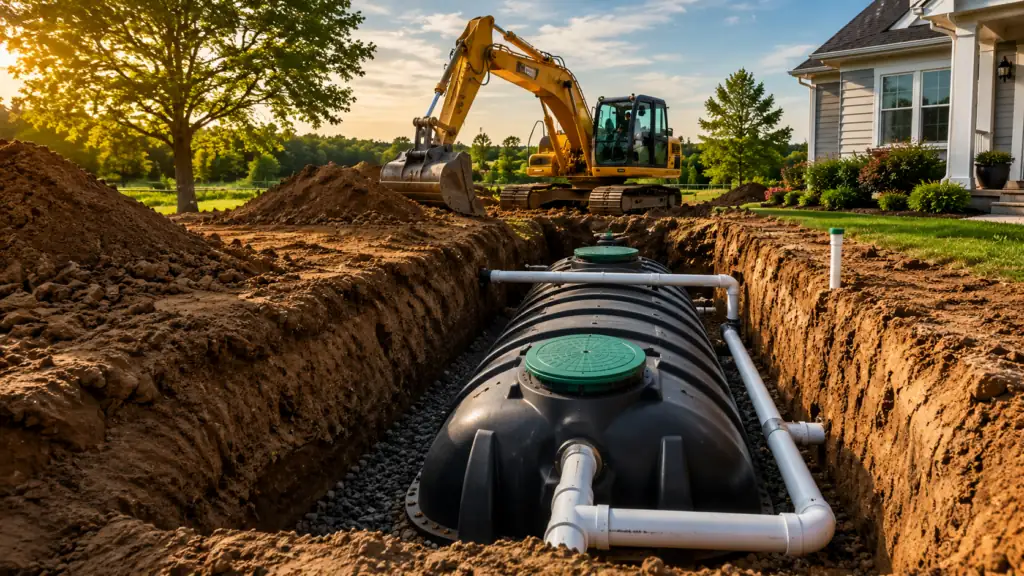
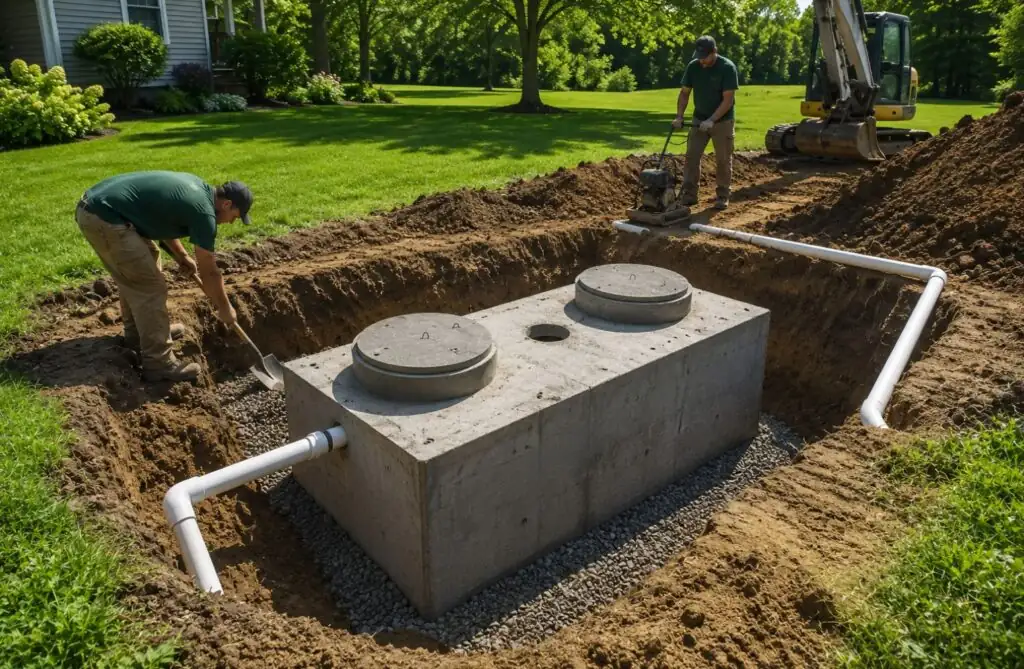
Septic tank installation in Lufkin, TX
Choosing the tank size before installation is far cheaper than upgrading later.

Tank materials and designs

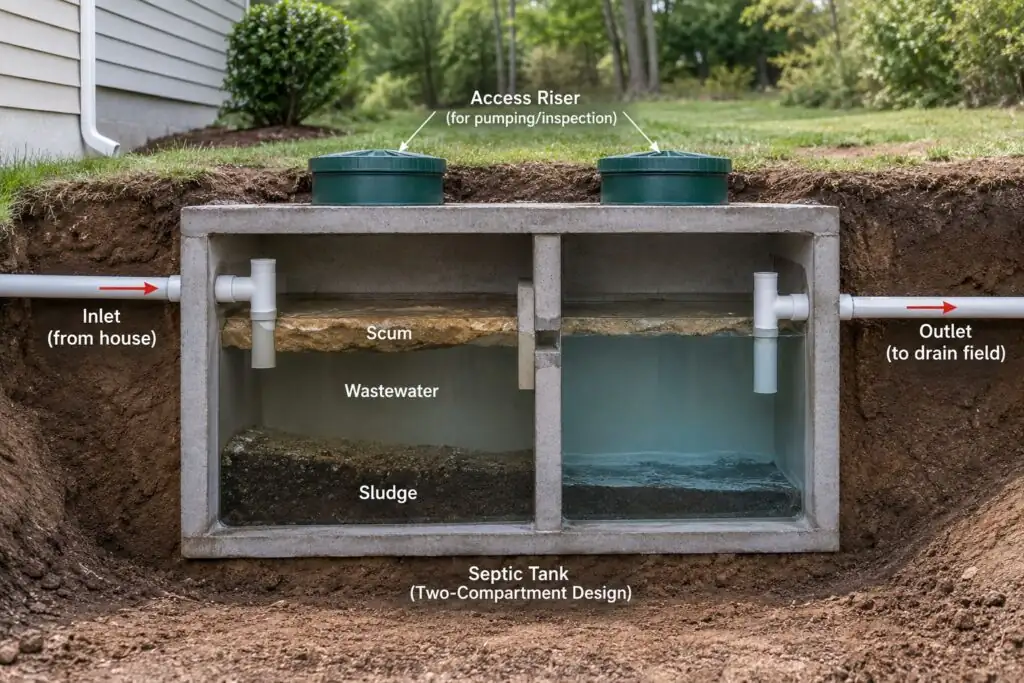
Most residential tanks in East Texas are precast concrete. Fiberglass and polyethylene tanks are lighter and easier to set where access is difficult, but they need care during installation and pumping, especially where groundwater is high, because an empty lightweight tank can float. Two-compartment tanks, or two tanks in series, improve settling and are common in newer designs. Whatever the material, the tank must be watertight, and it should have accessible lids or risers so it can be inspected and pumped without digging.

Signs your existing tank may be too small

  • You need pumping far more often than the typical three to five years.
  • Drains slow down or gurgle when you have guests or run several loads of laundry.
  • Problems started after a remodel, an addition or a larger family moving in.
  • The permit file shows the system was designed for fewer bedrooms than the house now has.

These can also be signs of other problems, so it is worth having the system inspected rather than assuming. See our guide to warning signs of septic failure.

How to find out what size tank you have

Start with the permit file. In Angelina County, the Angelina & Neches River Authority keeps records for permitted systems. A previous pumping receipt often lists the gallons removed, which is a good indication of size. Otherwise, a technician can estimate capacity from the tank’s dimensions during an inspection. Knowing your tank size is also the first step in setting a sensible pumping schedule.

Worked examples: three East Texas homes

A new three-bedroom home outside Lufkin

A 1,800-square-foot, three-bedroom house with modern low-flow fixtures has a design flow of 240 gallons per day, so the minimum conventional tank is 750 gallons. Most owners would choose 1,000 gallons for a longer pumping interval. If the site evaluation finds clay loam, a standard drain field would need roughly 1,200 square feet of absorptive area. If it finds heavy clay or a seasonal water table close to the surface, the design will likely switch to an aerobic unit rated at 360 gallons per day with spray or drip dispersal.

A two-bedroom lake house near Sam Rayburn

A two-bedroom house of 2,200 square feet sounds small, but because it is over 1,500 square feet it is sized like a three-bedroom home: 240 gallons per day with water-saving fixtures. On a lake lot, the bigger constraints are usually setbacks. State rules keep a standard drain field at least 75 feet from the lake’s normal pool level, and lots inside Control Zone Rayburn fall under additional local rules. On a narrow lot, that often decides the type of system more than the tank size does.

An older five-bedroom farmhouse

A 4,000-square-foot, five-bedroom home with older, full-flow fixtures has a design flow of 450 gallons per day, which calls for a minimum 1,250-gallon tank. With a large family and frequent guests, a 1,500-gallon tank or two tanks in series is a sensible upgrade. If the original system was sized for three bedrooms decades ago, this home is a strong candidate for an evaluation before the next problem appears.

Shops, RV spaces and non-residential uses

Texas sizes non-residential systems from the same Table III, using rates per unit of use instead of bedrooms. For example, the table allows 50 gallons per day per space for travel trailer and RV parks (40 with water-saving devices) and 200 gallons per day per washroom for stores (160 with water-saving devices). A shop with a bathroom, an RV pad with a sewer hookup or a small business on the property all add flow that has to be designed in. Combined systems and larger flows often need an engineer, so raise these uses early in the planning.

Frequently asked questions

Yes. A three-bedroom home under 2,500 square feet has a design flow of 240 gallons per day with water-saving fixtures, which requires a minimum of 750 gallons, or 300 gallons per day without them, which requires 1,000 gallons. A 1,000-gallon tank meets either case.

A four-bedroom home under 3,500 square feet needs at least 1,000 gallons with water-saving fixtures and 1,250 gallons without. Many four-bedroom homes use 1,250 or 1,500 gallons for longer pumping intervals.

Only if the existing system was sized for the larger home. If the addition pushes the design flow past what the system was permitted for, it will need to be upgraded, which requires a permit. Check before you build.

No. The drain field is sized from the design flow and the soil, not from the tank. A larger tank improves settling and extends pumping intervals, but it does not reduce the drain field area required.

Building, adding on or replacing an old system? Elite Septic Service sizes and installs septic systems across Lufkin, Jasper and East Texas, and we plan for the house you will have, not just the one you have today. Request a free estimate or read about septic tank installation and system replacement.

Need help with your septic system?

Damon Malnar, owner and founder of Elite Septic Service in Lufkin, Texas

Written by

Damon Malnar

Owner & Founder, Elite Septic Service

10 years installing, repairing, and inspecting septic systems across Lufkin, Jasper, and the surrounding East Texas counties.

TCEQ licenses

  • Installer, Class II
  • Site Evaluator
  • Maintenance Provider

More about Damon

Need service now?

Call for fast scheduling across East Texas.

Related Articles

Septic System Costs in East Texas: What Actually Drives the Price

Septic System Costs in East Texas: What Actually Drives the Price

Typical 2026 price ranges for conventional and aerobic systems in Texas, the site factors that push cost up or down, yearly running costs and how to compare quotes fairly.
Aerobic vs. Conventional Septic Systems: Which Is Right for Your Property?

Aerobic vs. Conventional Septic Systems: Which Is Right for Your Property?

How aerobic and conventional septic systems work, which one your soil calls for, what each costs to install and run, and the Texas maintenance rules for each.
Why Drain Fields Fail, and Whether Yours Can Be Saved

Why Drain Fields Fail, and Whether Yours Can Be Saved

What actually causes drain field failure, how to tell if yours is recoverable, and the repair options that work on East Texas soil.