Angelina County, Texas
Lufkin
Our home base. Septic permits here run through the Angelina & Neches River Authority.

Serving Groveton & Trinity County
Elite Septic Service installs, repairs, inspects and maintains septic systems for homes, RV parks, camps and businesses across Trinity County. We work the ground between the Trinity River and the upper end of Lake Livingston, we know the county’s fee schedule and its commercial testing requirements, and we answer the phone when a tank backs up on a Sunday night.
Flat-rate quote, usually same-day callback across Trinity County.

Local Septic Contractor
Trinity County is small, rural and considerably more commercial underneath than it looks. The county’s own septic fee schedule gives it away: alongside residential permits it prices commercial systems separately, charges per additional RV unit at business sites, and requires establishments serving food or alcohol to file monthly reports with BOD and TSS testing every six months. That is a county that knows it has campgrounds, RV parks, marinas and rural restaurants on on-site systems, and regulates them accordingly.
For a homeowner none of that applies. But it matters enormously if you run a park, a camp, a store with a kitchen or a bar anywhere in the county, because the obligations attached to a commercial system here go well beyond installing it and forgetting it. We work both sides — the house on ten acres outside Groveton and the RV park at the lake end — and we will tell you which set of rules you are actually under.
It changes who we file with, because permitting here runs through the County Judge’s office at the courthouse rather than a separate health department. It changes what we ask a business owner about: not just flow, but reporting and effluent testing. It changes the design on lakeside and river-bottom ground where the water table is the binding constraint. And on ten-acre-plus tracts it changes the paperwork, because the exemption route has its own affidavit.

Services in Trinity County
Everything we do is available anywhere in Trinity County — Groveton, Trinity, the lake end and the acreage in between — with no travel surcharge for being out of town.
New conventional and aerobic systems for houses, cabins, shops, parks and new construction. Commercial and multi-unit systems are a different design problem from a house, and they are permitted and priced differently by the county — we size for the actual peak load rather than a rule of thumb.
Cracked tanks and lids, failed baffles and tees, broken inlet and outlet lines, collapsed distribution boxes, effluent pumps, floats and alarms. On a commercial system a failed pump is not an inconvenience, it is a closure, so we carry the common parts rather than ordering them.
Real-estate and routine inspections with a written report and photographs. On a business purchase the inspection also needs to establish whether the system is sized and permitted for the use, and whether any reporting obligations attached to it have actually been met.
When a system has genuinely finished, we design and install its replacement, decommission the old tank properly, and size the new one for how the property is used today. On a park or camp that means designing around the busiest weekend of the year, not the quietest.
Backups into the house, sewage surfacing in the yard, alarms that will not clear and tanks overflowing after heavy rain. Available 24 hours a day across Trinity County — and for a park or a kitchen, treated with the urgency a business losing trading hours deserves.
Routine pump-outs, filter cleaning, aerobic maintenance visits and the four-monthly inspections Texas requires on aerobic units. For commercial systems under a reporting obligation, regular maintenance is not optional housekeeping, it is what keeps the paperwork honest.
Slow drains, recurring clogs and lines that back up before the tank does. Commercial kitchens are their own problem here — grease narrows a line long before it blocks it, and the failure invariably arrives on a Friday evening.
Cracked, offset, root-invaded and crushed lines between the building and the tank. On a park with vehicle traffic over shallow lines this is a recurring cause, and locating the fault before excavating keeps the disruption to one site rather than the whole property.
A camera down the line locates the break, the belly or the root intrusion precisely. On a property that has been added to over the years — which describes most parks and older camps — tracing what actually runs where is the first useful step.
Trinity County work spans houses, hunting camps, RV parks and commercial sites around Groveton, Trinity and Apple Springs. Camps and parks lean on regular septic maintenance and drain cleaning through the busy season, while older homes need septic tank repair, sewer line repair or a camera inspection of the line. Buyers book septic inspections before closing, new sites get septic installation sized for the use, worn-out fields get full replacement, and emergency septic service covers the whole county. Or browse the full list of our septic services.
Common Problems
These are the recurring calls from Trinity County addresses, residential and commercial alike. Wet ground and variable load account for most of them.
An RV park or campground can go from a handful of units midweek to full on a holiday weekend. A system sized on average flow has no reserve for that, and the failure arrives at the exact moment the business can least afford it.
Cooking fat sets on the pipe wall and narrows the bore over months. The drains slow gradually, nobody acts, and the line finally closes during service. On a food business under a reporting obligation this is a compliance problem as well as a plumbing one.
The upper end of Lake Livingston and the Trinity bottoms hold water for long stretches. A drainfield needs unsaturated soil beneath it; when the water table rises into that zone the field stops absorbing however well it was built.
Compressors, pumps and chlorinators fail quietly, and on a seasonal property the alarm sounds to nobody. Texas requires inspection every four months for exactly this reason, and a lapsed contract is usually discovered either at a sale or when the spray field starts smelling.
Common on parks, camps and rural properties with working vehicles. Pipe laid shallow decades ago does not survive loaded trucks and trailers crossing it, and the damage shows up weeks later as a slow drain rather than as an obvious break.
Two clear weeks and then the same backup. That is a field that has stopped accepting rather than a tank that was merely full, and on a park it will recur every busy weekend until it is dealt with properly.
An extra RV pad, a second cabin, a bathroom in a shop. Each adds flow the design never allowed for and each is an alteration of the facility rather than plumbing work. It usually comes to light at a sale or an inspection.
Where a business serves food or alcohol, Trinity County requires monthly reporting and effluent testing every six months. When a property changes hands that obligation does not disappear, and new owners are regularly unaware it exists at all.
Nobody knows the tank size, the system type or where the field runs. Locating and documenting it becomes the first job rather than something we guess at from the surface, particularly before any money is spent on a repair.
If any of that sounds like your property, an inspection will tell you which one it is before you spend anything. You can also read our guide to the seven warning signs a septic system is failing and why drainfields fail.
Local Ground Conditions
The physical constraints here are mostly about water — where it sits, how long it stays, and what that leaves a drainfield to work with.
Trinity County runs from the Trinity River along its western edge across to the Neches on the Angelina County line, with the upper end of Lake Livingston reaching into its south-eastern corner and the Davy Crockett National Forest touching the north. Very little of the county is far from significant water, and the bottomland along both rivers and their feeder creeks holds moisture long after the rain stops. That single fact does more to determine septic design here than soil texture does.
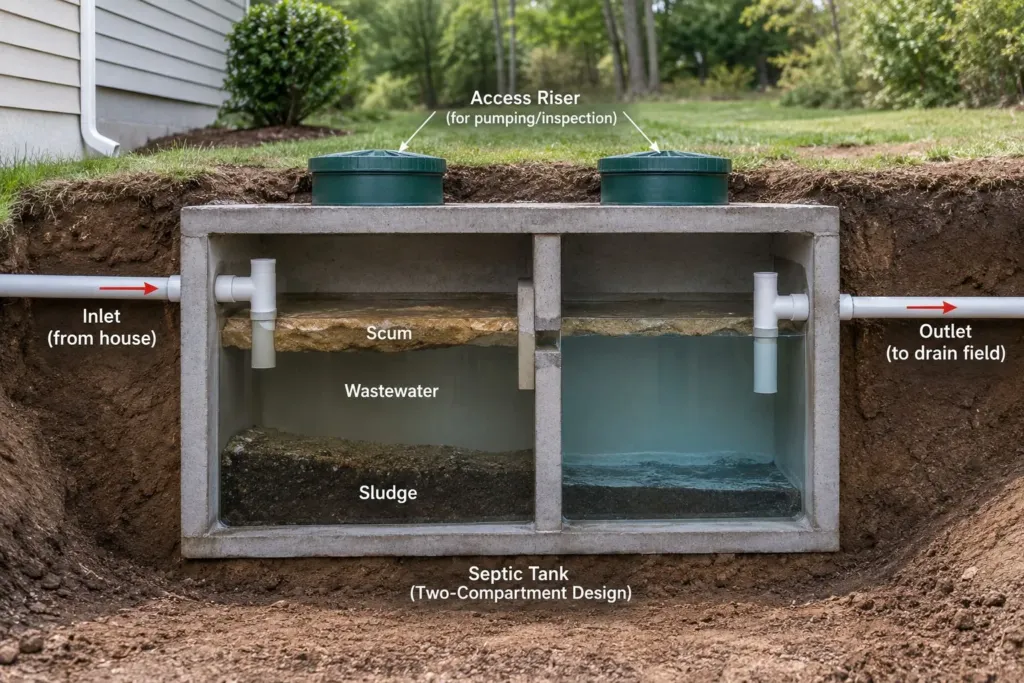
A conventional drainfield works by dispersing effluent into unsaturated soil beneath the trenches. Where the seasonal high water table rises into that zone, the field has nothing to disperse into and effluent surfaces instead. This is why a system can behave perfectly through a dry autumn and fail in February, and why a site evaluation here pays particular attention to depth to groundwater rather than simply to how quickly a test hole drains.
This part of Texas takes roughly fifty inches of rain a year, and most of it falls when evaporation is lowest and the ground least able to shed it. Rain arriving on an already saturated profile is exactly the load a marginal field cannot absorb. It is also why we judge a questionable system by how it behaves in winter: a field that copes in August tells you very little, and the first sustained wet spell each year produces a predictable run of emergency calls.
A house produces fairly predictable daily flow. An RV park, a campground, a store with a kitchen or a bar produces flow that swings wildly by day and season, and carries a much heavier organic load. That is why the county prices commercial permits separately, charges per additional RV unit at business sites, and requires food and alcohol establishments to report monthly and test effluent every six months. Sizing a commercial system on residential assumptions is how a business ends up closed on its busiest weekend.
On higher ground away from the bottoms with enough room and enough depth of suitable soil, a conventional gravity field remains the cheaper and simpler option. Near the lake, in the river bottoms, on smaller lots or anywhere the water table cuts into the profile, an aerobic treatment unit is frequently the only reliable answer — it treats the wastewater before dispersal, so it needs far less soil to do the work. The trade-off is mains power, moving parts, a maintenance contract and inspections every four months. Our comparison of aerobic vs. conventional septic systems sets the costs out side by side.
Permits & Rules
Trinity County runs its own on-site sewage programme out of the courthouse, and it publishes its fee schedule. Here is how the process works and what we handle for you.
On-site sewage facilities in Trinity County are handled through the County Judge’s office at the Trinity County Courthouse, 162 West 1st Street, Groveton, on 936-642-1746. That is one office for the whole county, covering permits, forms, maintenance reporting and inspections — which is simpler to plan around than counties where jurisdiction depends on proximity to a reservoir. It is also a small office, so getting an application right the first time genuinely speeds things up.
The sequence follows TCEQ rules. A licensed site evaluator or professional engineer assesses the lot and the soil, including depth to any restrictive horizon and to the seasonal high water table, which is the figure that matters most in this county. Planning materials and the application go to the county, which has 30 days under state rules to approve or deny. Installation must be by an appropriately licensed installer, and the system is inspected before it is covered. An uninspected system is an unpermitted one, and that is a problem you inherit rather than escape.
The county’s published schedule puts a standard residential permit at $325, and residential multi-family at the same $325. Commercial and business permits are $450, with an additional $50 per RV unit at business sites. An affidavit — whether for an aerobic system or a ten-acre exemption — is $25. Fees do change, so we confirm the current schedule with the county before quoting and it appears in your estimate rather than as a surprise afterwards.
This is the Trinity County requirement that catches business owners out. The county requires entities serving alcoholic beverages or food to submit monthly reports and to carry out BOD and TSS effluent testing every six months. If you run a restaurant, a bar, a store with a kitchen, a marina or a camp that feeds people, that obligation attaches to your system and it does not go away when the property changes hands. If you have just bought such a business and nobody mentioned this, it is worth checking where the reporting stands before somebody else does.
Aerobic units require a maintenance contract with a licensed provider and inspections every four months under Texas rules, with the obligation recorded so it follows the property. Trinity County handles both aerobic and ten-acre exemption situations through a filed affidavit, currently $25. Both routes are routine when handled at the time and awkward when reconstructed years later, which is generally when they come up. Our guide to septic inspections before buying a home covers what to check.
Get the system inspected during the option period, and if it is a business, ask about reporting as well as condition. The questions that matter are whether the system is permitted for the use it is actually put to, whether every addition — extra RV pads, a second cabin, a shop bathroom — was authorised, whether an aerobic maintenance contract is active, and whether any monthly reporting and six-monthly testing has actually been done. All of it is negotiable before closing and yours afterwards.
For a fuller walk-through of how Texas OSSF permitting works, read our guide to septic permits in East Texas.
Why Us
We have worked on septic systems across this region for 10 years — houses, camps, parks and commercial sites, on ground ranging from dry upland to river bottom. Recognising a drainfield six months from failing takes that kind of time behind you.
Parks, camps, kitchens and multi-unit sites are a different design and a different compliance problem from a house. We size for real peak load and we will tell you what reporting your system actually carries rather than leaving you to discover it.
Licensed installers, full insurance, and permits filed through the county the way the rules require. Unpermitted additions become the seller's problem at closing, and we have been called in to unpick enough of them to take this seriously.
Trinity County publishes its schedule, so you see the work price and the permit price separately before anything starts. Neither moves once we begin, and a commercial job is quoted as a commercial job from the outset.
A repair that buys eight years is good value; one that buys eight months is money spent twice. On a business that difference is not just cost — it is whether you are closed again next season.
A backup at a house is miserable. A backup at a park or a kitchen is lost trade and, potentially, a closure. We run emergency response around the clock across Trinity County and we prioritise accordingly.

Any contractor worth hiring answers all seven before taking a deposit. If you run a business, the third and fourth questions are the ones that matter most. There is more about the crew on our about page.
Service Area
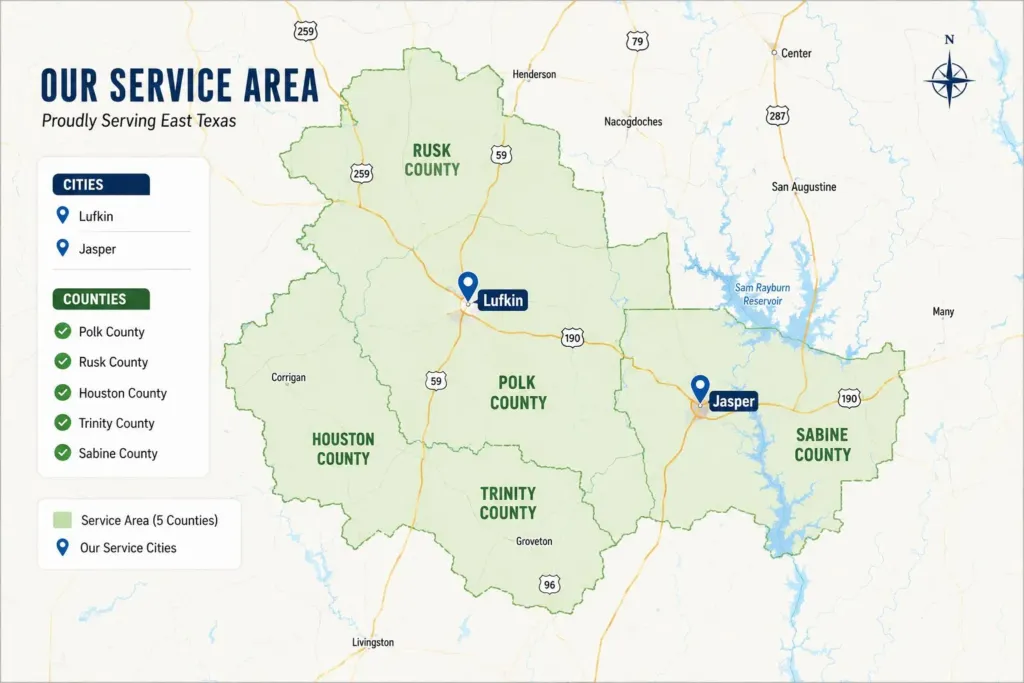
Groveton and Trinity carry municipal sewer across parts of town, so the septic work sits in the outer neighbourhoods, the lake end, the river country and the acreage that makes up most of the county.
Apple Springs, Pennington or a road off FM 356 — the price is the same as in Groveton. If you are not sure your address is inside the area, ring us and read out the road name. You can see the wider coverage on our service areas page. Nearby, we also cover Polk County and Lake Livingston and Houston County.
Nearby Areas
The same crew covers the rest of our East Texas area. Each location has its own service pages, written for its soil, water and permitting.
Angelina County, Texas
Our home base. Septic permits here run through the Angelina & Neches River Authority.
Jasper County, Texas
Lots near Sam Rayburn fall inside a control zone with its own septic rules.
County seat: Livingston
Small lake lots around Lake Livingston, permitted through the county office in Livingston.
County seat: Henderson
Oilfield country, where pipeline easements often decide where a drainfield can go.
County seat: Crockett
Heavier Post Oak soil toward the Trinity, sandier ground toward the Neches.
County seat: Hemphill
Toledo Bend on one side, Sam Rayburn on the other, and national forest in between.
Common questions from homeowners, business owners and buyers across Trinity County. If yours is not here, call and ask.
Tell us the address and what is happening — a backup, a smell, an alarm, a purchase, a new build or a park that will not cope with the season. We will tell you whether it needs someone today or an appointment this week, confirm whether you are under residential or commercial rules, give you a free estimate, and agree the price before any work starts.