
Drain & Sewer Line Cleaning
Drain Cleaning in Lufkin, TX
A slow drain is a warning. A backed-up one is the bill arriving. Elite Septic Service clears blocked drains, building lines and septic lines across Lufkin, Angelina County and the surrounding East Texas counties — and tells you honestly whether the line needed cleaning or whether something underneath it needs fixing.
- Same-day clearing for backed-up drains across most of Angelina County
- Cable machines and hydro-jetting, matched to what is actually in the pipe
- An honest answer on whether cleaning fixes it or only buys you time

Drain Cleaning Overview
Why Drains Block on Septic Systems
On city sewer, a blocked drain is usually just a blocked drain. On a septic system it is rarely that simple, because everything the house sends out ends up in a tank on your own property. A drain that will not clear can be reporting a problem anywhere between the trap under the sink and the far end of the drainfield.
So the first thing we do is establish where the restriction actually is. If every fixture in the house is slow, the problem is not the kitchen sink. If the lowest fixture backs up when the washing machine drains, the line out to the tank is involved. If the tank is full to the inlet, no amount of cabling the house drain will help, because the line is not blocked — it has nowhere to empty into. Cleaning the wrong thing is the most common way money gets wasted on this work.
Cleaning a drain is not the same as pumping a tank
These two get treated as interchangeable and they are not. Pumping empties the tank. Drain cleaning clears the pipes — the fixture drains inside the house, the building drain, and the line running out to the tank. A tank at a normal level with a blocked line needs cleaning. A clear line running into an overfull tank needs pumping. Both at once needs both, in that order.
We would rather spend ten minutes working out which of those you have than sell you the wrong one. Describe what is happening when you call and we usually have a good idea before the truck leaves. If the answer turns out to be pumping, or a drainfield problem rather than a blockage, we will say so on site instead of cabling a line that was never the issue.
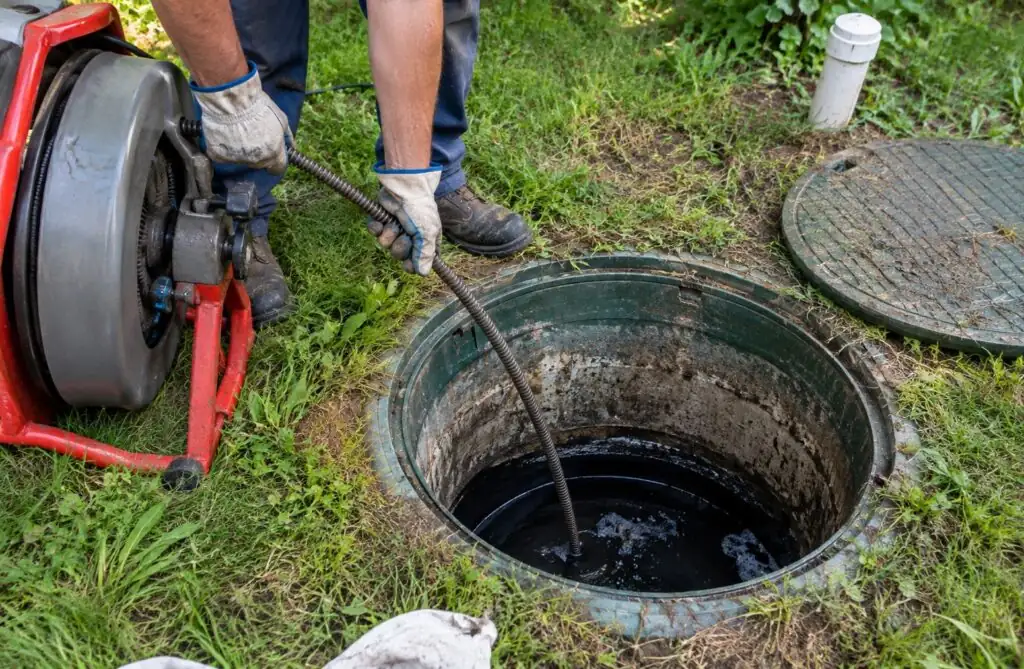
What you get with every drain cleaning visit
- The restriction located before anything goes into the pipe
- Cable or jetting chosen to suit the blockage, not whatever is on the truck
- The line run through and tested with water before we call it clear
- A straight answer on what caused it and whether it will come back
- A camera inspection offered where the blockage looks structural
- Flat-rate pricing agreed before we start, and free estimates
What We Clear
What Blocks Drains on East Texas Properties
These are the causes we find most often on Lufkin-area properties, roughly in the order they turn up.
Root Intrusion at the Joints
Pine and hardwood roots find the wettest ground on a property and grow into it. Once they are through a joint they act like a net, catching everything that passes until the pipe closes. Cutting them out restores flow; it does not stop them coming back, which is a separate conversation worth having.
Grease in the Kitchen Line
Cooking fat goes down warm and sets on the pipe wall cold. It narrows the bore over years, which is why the kitchen drain slowed gradually rather than stopping one day. A cable punches a hole through it; jetting takes the wall back to bare pipe so it stays clear longer.
Wipes and Non-Flushables
Flushable wipes are not. They do not break down, they snag on anything rough inside the line, and then they collect everything behind them. On a septic system they also survive the tank and reach the drainfield, which is a far more expensive problem than the blockage was.
Paper and Solids Overload
A line laid with marginal fall will pass normal use for years and then stop coping when the household grows or a guest bathroom comes into daily use. The blockage is real, but the cause is the grade of the pipe rather than anything that went down it.
Sags and Bellies Holding Water
Where the ground has settled under a section, the pipe dips and standing water sits in it. Solids drop out in the low spot and build up. Cleaning clears it, and it blocks again on the same schedule until that section is dug up and re-laid to fall.
Scale in Older Cast Iron
Cast iron corrodes from the inside, and the rough scale that forms catches paper and grease. Plenty of older Lufkin houses still have it under the slab. Jetting can restore a usable bore; badly deteriorated sections are a replacement job rather than a cleaning one.
Foreign Objects
Toys, cleaning cloths, dental floss, sanitary products, the occasional phone. Anything rigid that lodges at a bend becomes the anchor for everything that follows. These usually need retrieving or cutting rather than pushing, which is worth knowing before somebody forces it further down the line.
A Full or Failing Tank
If the tank is full to the inlet, the house line has nowhere to drain and every fixture slows. Nothing is blocked. This is the single most common reason a drain cleaning gets booked on a septic property when what is actually needed is pumping.
Drainfield Backpressure
When the field stops accepting water, the tank stays full, the line will not empty and the house backs up. From inside the house the symptoms look identical to a blockage. Telling these apart at the tank lid, before cabling anything, is most of the diagnosis.
Collapsed or Broken Pipe
Ground movement, root pressure, or a vehicle driven over a shallow line. Once a section has crushed or dropped out of alignment nothing passes, and no cleaning will change that. A camera confirms it in minutes and saves paying for a clearing that could never have worked.
Where cleaning is not the answer, we can take the job the rest of the way: sewer camera inspection to see what is actually down there, sewer line repair, septic tank repair, system replacement, and 24/7 emergency septic service when it will not wait.
Step By Step
How a Drain Cleaning Visit Works
Nothing about this needs to be mysterious. Here is the order we work in and why.
1. Tell Us What Is Happening
Which fixtures are affected, whether it is one drain or all of them, how long it has been building, and whether anything has already been tried. One slow sink and a whole house backing up are different jobs, and knowing which we are coming to changes what comes off the truck.
2. Check the Tank Before the Pipe
On a septic property we lift the lid first. A tank sitting at or above the inlet means the line is not blocked, it is backed up, and cabling it would achieve nothing. Two minutes here prevents the most expensive mistake in this trade.
3. Find the Right Access Point
A cleanout where there is one, otherwise a pulled toilet, a roof vent, or the tank inlet depending on the layout. On older rural properties without a cleanout, working out a sensible way in is part of the visit, and we will tell you if installing one is worth doing.
4. Clear the Line
A cable machine with the cutting head matched to the pipe for roots and solid obstructions; hydro-jetting where grease, scale or sludge has coated the wall and a hole through the middle would not last. The method follows the blockage rather than the other way round.
5. Prove It Is Clear
We run water through the line and watch it go. A drain that gulps, gurgles or backs up under volume is not finished, whatever it looked like a minute earlier. If it will not hold up under a real flow test, we keep working.
6. Tell You Why It Blocked
What came out, what caused it, and whether it is likely to return. Roots and bellies come back on a predictable cycle; a one-off obstruction does not. Where the cause looks structural we will suggest putting a camera down before you spend money on this twice.
How long does a drain cleaning take?
Most straightforward blockages are cleared within an hour or two of arriving. A kitchen line full of grease, a toilet line with roots at a single joint, a blocked fixture drain — these are routine and usually done in one visit. The time goes up when access has to be created first, when the cleanout is buried or was never installed, or when the line is long and the blockage sits near the far end. Hydro-jetting a heavily coated line takes longer than cabling one, because the point is to take the wall back rather than punch through the middle. If we get in there and find a collapse, a belly or a separated joint, we will stop and tell you rather than keep charging for a clearing that cannot work.
When Drain Cleaning Is the Right Call
Cleaning solves a specific set of problems very well. These are the situations where it is the right first move:
- One or more fixtures draining slowly with no backup yet
- A kitchen line that has been getting worse over months or years
- A toilet or tub that backs up and then clears on its own
- Gurgling from traps when another fixture drains
- A line with a known root problem due for its scheduled clearing
- Before selling or letting a property, so nothing surprises anyone
- After a tank pump-out, to clear what the line held onto
What these have in common is a pipe that is sound but obstructed. Where the pipe itself is the problem — broken, sagging, out of alignment — cleaning buys time rather than fixing anything, and we will say so rather than putting you on a schedule of repeat visits.
Who Calls Us
Drain Cleaning for Homeowners, Landlords and Businesses
The work is the same; what people need from it is not. Here is how the job usually looks depending on who is calling.
A household with one slow drain
The most common call, and usually the cheapest to deal with if it is caught early. A single fixture draining slowly is normally a local problem — grease, hair, a trap full of debris — and it stays a small job for as long as it is one fixture. Once the whole house slows together, the line out to the tank is involved and the visit gets longer.
A house that has backed up
Different priority entirely. Sewage on a floor is a health problem and a clock, so this gets handled as an emergency: stop the household using water, find out whether it is the line or the tank, and clear it. Once things are moving again we work out why it happened, because a backup that had no obvious cause will happen again.
A line that keeps blocking
If the same line has been cleared two or three times and keeps closing up, cleaning is no longer the answer on its own. Something structural is catching everything that passes. This is where a camera pays for itself, because it turns an open-ended series of call-outs into one defined repair.
Landlords and property managers
Recurring drain complaints at a rental are expensive in call-outs and in goodwill, and tenants are rarely the cause people assume they are. Establishing once whether the line is sound, and putting a known root problem on a schedule rather than an emergency footing, turns an unpredictable cost into a budgeted one.
Restaurants and commercial kitchens
Commercial lines carry heavier and greasier loads, and grease narrows a pipe long before it blocks it. Jetting on a sensible interval keeps the bore open and keeps you out of a shutdown at the worst possible hour. We will tell you what interval your line actually needs rather than sell you a standard one.
Alongside a tank pump-out
Where a system has been neglected for years, pumping the tank and cleaning the lines belong together. The tank comes back to a working level, the line gives up what it has been holding, and the system starts from a known state instead of leaving you wondering which half was the problem.
What Comes Next
When Cleaning Fixes It and When It Does Not
A drain cleaning is worth what it costs when it solves the problem rather than postponing it. What we find in the line tends to point one of two ways.
Problems a cleaning usually solves for good
- Grease and soap buildup coating an otherwise sound pipe
- Hair, debris and solids caught in a fixture trap or branch line
- Paper and waste that accumulated after an unusual load on the system
- A single foreign object lodged at a bend or transition
- Fine root hairs that have entered but not yet displaced a joint
- Scale in cast iron where enough sound pipe wall remains
- A line that has simply never been cleaned in decades of use
Problems that need more than cleaning
- A collapsed or crushed section, where nothing can pass at all
- Heavy root masses that have already broken or displaced a joint
- A belly or sag holding standing water, which will keep re-blocking
- Joints that have separated or dropped out of alignment
- A tank that needs pumping, or a drainfield that has stopped accepting
- Deteriorated Orangeburg or cast iron near the end of its life
- A line laid to the wrong fall, which no amount of cleaning corrects
Why Us
Why Choose Elite Septic Service for Drain Cleaning
We Check the Tank First
On a septic property the tank is the first thing we look at, because a full tank and a blocked line produce identical symptoms indoors and only one of them is fixed by a cable. Plenty of drain cleanings get sold on septic systems that never needed one.
10 Years on These Lines
We have worked on septic and sewer lines across East Texas for 10 years. Knowing what a line is likely to be made of, where it probably runs and what usually fails on a property of that age gets to the answer considerably faster.
Cable and Jetting, Not One or the Other
Roots and solid obstructions want a cable with the right cutting head. Grease, sludge and scale want water at pressure. Companies carrying only one tool tend to recommend only one solution, and the line is the thing that suffers for it.
We Tell You When It Will Come Back
A cleared line is not always a fixed line. If the cause was roots at a joint or a belly holding water, you will see us again on a schedule, and you deserve to know that on the day rather than the next time it blocks.
We Can Do the Repair Too
Where the line needs opening up, the crew that cleared it is the crew that repairs it. Diagnosis and repair do not get split between two companies with different opinions about what is wrong down there.
No Manufactured Urgency
If the blockage was a one-off and the line is sound, we say so and leave. Drain cleaning is easy work to oversell, and we would rather you called us again in three years than felt sold to today.
Licensed, Insured and Locally Based
Elite Septic Service is a locally owned, licensed and insured contractor working across Lufkin, Jasper and the surrounding East Texas counties, with free estimates and flat-rate pricing agreed before work starts.

Questions worth asking before booking a drain cleaning
- Will you check the septic tank before you cable the line?
- Do you carry both a cable machine and a jetter?
- How will you confirm the line is actually clear before leaving?
- Will you tell me what caused it and whether it will happen again?
- What happens if you find the pipe itself is broken?
- Is the price flat-rate, or does it climb by the hour?
- Are you licensed and insured for septic work in Texas?
We answer all seven before booking anything — and you should expect the same from anyone else you call.
Warning Signs
Signs Your Drains Need Cleaning
Any one of these is worth a call before it becomes a backup. Several together usually mean the main line out to the tank is involved rather than a single fixture.
One fixture draining slowly
A single slow sink, tub or shower is a local problem and the cheapest version of this job. Left alone it does not stay local — the restriction collects more of what passes it until the branch line closes entirely.
Everything slowing at once
Sinks, tubs and toilets all draining slowly together points at the main line out of the building or at the tank, not at any one fixture. This is the version that ends in a backup if it is ignored.
Gurgling toilets and traps
Air being pushed back through the water in a trap means the line is not clearing freely. It is one of the earliest signs of a partial obstruction and usually shows up weeks before anything overflows.
The lowest fixture backs up
When the washing machine or a shower drains and the downstairs toilet or floor drain rises, the restriction is downstream of both. That is the main line, and it is past the point where a plunger is going to help.
A drain that clears then returns
Blockages that clear on their own overnight and come back in a week are partial obstructions, not resolved ones. The line is passing just enough to drain slowly and catching a little more each time.
Sewage odor indoors
A working drain is sealed by the water in its traps. Persistent sewage smell means either a trap has dried out or waste is sitting in a line where it should be moving through.
Wet ground over the line
Ground that stays soggy or smells along the run between house and tank suggests effluent escaping rather than a simple blockage. That is a repair question, and cleaning would only postpone finding out.
The same blockage every year
A line that closes up on a predictable cycle has a structural cause — usually roots at a joint or a low spot holding solids. Cleaning keeps it working; a camera tells you what you are actually dealing with.
Nobody has cleaned it in decades
Older properties where the lines have never been touched are carrying a lifetime of grease, scale and paper on the pipe wall. They usually still drain, right up until the day a normal load tips them over.
Not sure whether you need a drain cleaning, a tank pump-out or a full septic inspection? Describe the symptoms when you call and we will tell you which one answers your question before you pay for the other.
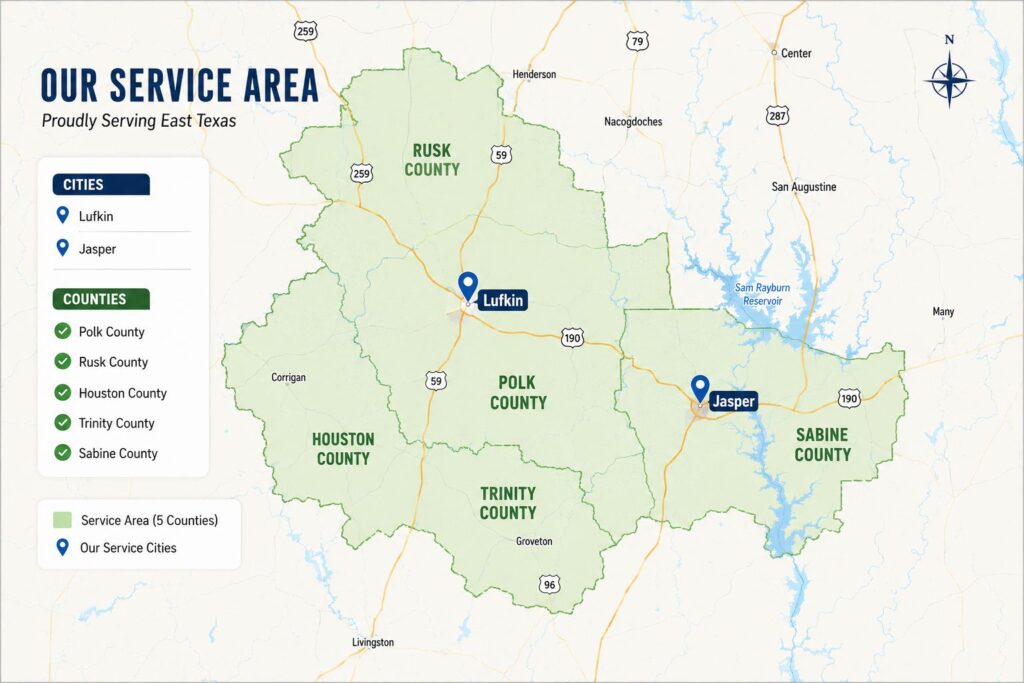
Where We Work
Drain Cleaning Across Lufkin and East Texas
What blocks a drain here is shaped by local conditions. East Texas is pine and hardwood country, and roots head for the wettest ground on a property, which is the sewer line. Add the older clay and Orangeburg pipe still in service around Lufkin, heavy clay soil that shifts as it wets and dries, and long wet spells that keep the ground moving, and root intrusion at separated joints becomes the most common thing we cut out of a line.
Rural properties bring a second issue: almost everything runs to a septic system rather than a sewer main, which means a blocked drain is never only a plumbing question. The tank, the line and the drainfield are one system, and a symptom in the house can originate anywhere along it. We clear drains throughout:
Whatever we find in the line, we can take it from there: sewer camera inspection, sewer line repair, septic tank repair, scheduled maintenance, or 24/7 emergency septic service. See all of our septic services, or check the full East Texas service area if your property is not listed above.
More septic services in Lufkin, TX: septic tank installation, septic tank repair, septic tank inspection, septic system replacement, emergency septic service, septic system maintenance, sewer line repair and sewer camera inspection. See everything we offer locally on our septic service in Lufkin, TX page.
Drain Cleaning FAQs
Common questions about drain and sewer line cleaning across Lufkin and East Texas. If yours is not here, call and ask.
How much does drain cleaning cost in Lufkin?
Can I just use a chemical drain cleaner?
What is the difference between cabling and hydro-jetting?
Will drain cleaning damage my pipes?
Do I need my drains cleaned or my septic tank pumped?
How often should drains be cleaned?
Can you clear a drain if I do not have a cleanout?
Why does my drain keep blocking in the same place?
Do you handle emergency backups?
How do I book a drain cleaning in Lufkin?
Need a Drain Cleared in Lufkin, TX?
Tell us the address, which drains are affected and how long it has been building. We will check the tank before we touch the line, clear it with the right tool for what is in there, test it under real flow, and tell you honestly whether that is the end of it — with flat-rate pricing agreed before we start.
- Same-day response for backups across most of Angelina County
- The tank checked first, so you are not sold a cleaning you did not need
- Free estimates and flat-rate pricing agreed up front