
Serving Henderson & Rusk County
Septic Service in Rusk County, TX
Elite Septic Service installs, repairs, inspects and maintains septic systems for homes, farms and businesses across Rusk County. We work the sandy oilfield country around Henderson, Tatum and Overton, we plan around the pipeline and utility easements that thread this county, and we answer the phone when a tank backs up on a Sunday night.
- 10 years on East Texas septic systems
- Free estimates and flat-rate pricing agreed up front
- Scheduled work and emergency response across Rusk County

Local Septic Contractor
A Septic Company That Works Rusk County Acreage
Rusk County is oil country, and that shapes septic work here in ways people do not expect. This is the heart of the East Texas Oil Field, and a century of drilling, gathering lines, tank batteries and utility corridors has left the county threaded with easements. An easement is not just a line on a plat — it is ground you cannot build a drainfield across, and on a rural tract it can remove exactly the part of the property that would otherwise have been the obvious place to put one.
The soils help. Much of Rusk County carries the deep sandy and loamy ground typical of this part of East Texas, which generally percolates far better than the claypan further south around Lufkin. A conventional gravity drainfield is a realistic option on plenty of properties here. The constraint is usually geometry and title rather than soil chemistry: where can the field legally go, once the easements, the well, the property lines and any surface water have had their say.
What working in Rusk County actually changes
It changes where we look first, which is at the plat and the easements before the soil. It changes system selection, because sandier ground genuinely opens up cheaper options that heavy clay would rule out. It changes how we handle older rural systems that have never been documented, of which this county has a great many. And it changes the paperwork, because Rusk County handles on-site sewage through a designated representative rather than a large permitting department.
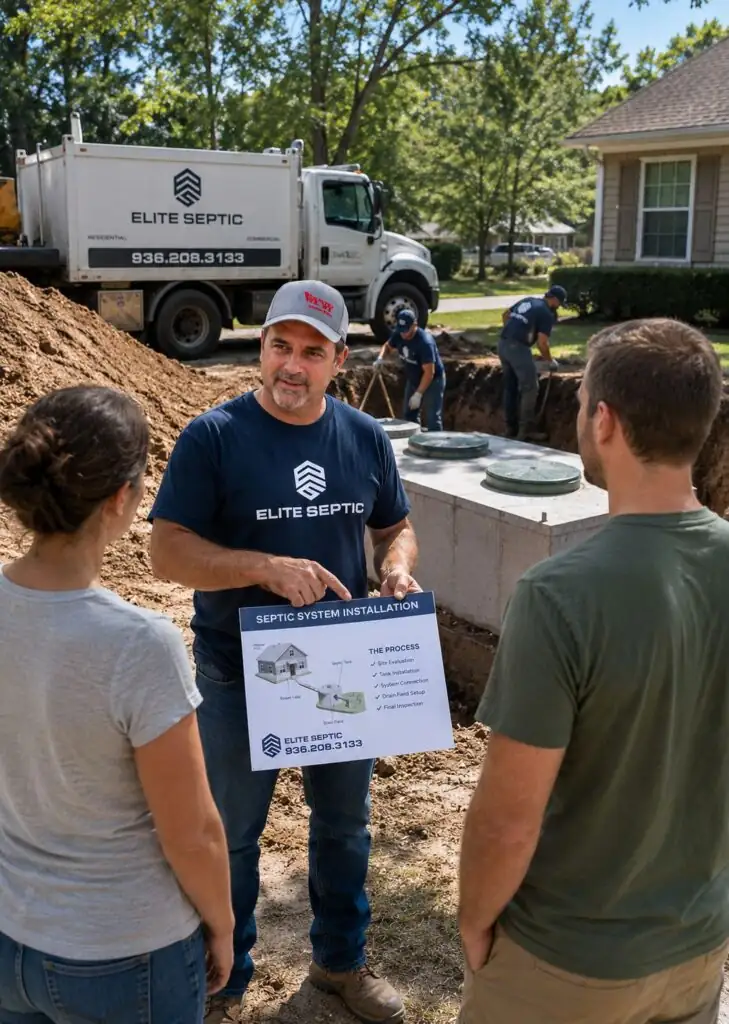
What you get on every Rusk County call
- A licensed, insured crew, and no subcontracted trucks
- Easements, the well and the boundaries mapped before design
- A free written estimate that does not move afterwards
- Photographs of what we found, not just a verbal summary
- Paperwork filed with the county representative on your behalf
- Emergency cover, with an honest arrival time given up front
Services in Rusk County
Septic Services We Provide in Rusk County, TX
Everything we do is available anywhere in Rusk County — Henderson, the smaller towns and the acreage in between — with no travel surcharge for being a long way out.
Septic Tank Installation
New conventional and aerobic systems for houses, shops, barns and new construction. On Rusk County's sandier ground a gravity drainfield is often viable and cheaper to own — but the field has to fit clear of easements, wells and boundaries, and that is what we establish first.
Septic Tank Repair
Cracked tanks and lids, failed baffles and tees, broken inlet and outlet lines, collapsed distribution boxes, effluent pumps, floats and alarms. Rural properties here tend to have long runs and old components, so the fault is often somewhere between the house and the tank rather than in either of them.
Septic Inspections
Real-estate and routine inspections with a written report and photographs. A great deal of Rusk County housing stock predates modern permitting, and knowing what is actually buried — and whether it could be replaced legally — is the difference between a confident purchase and an expensive surprise.
Septic System Replacement
When a system has genuinely finished, we design and install its replacement, decommission the old tank properly, and size the new one for how the property is used today. On acreage that usually means more options, provided the easements leave somewhere usable.
Emergency Septic Service
Backups into the house, sewage surfacing in the yard, alarms that will not clear and tanks overflowing after heavy rain. We respond around the clock; Rusk County is the northern end of our area, so we will tell you honestly how quickly we can be there.
Pumping & Maintenance
Routine pump-outs, filter cleaning, aerobic maintenance visits and the four-monthly inspections Texas requires on aerobic units. On rural properties where nothing gets noticed until it fails, a scheduled visit is the cheapest septic work you will ever pay for.
Drain Cleaning
Slow drains, recurring clogs and lines that back up before the tank does. We check the tank before we cable the line, because a full tank and a blocked line look identical from inside the house and only one of them is fixed by a cable.
Sewer Line Repair
Cracked, offset, root-invaded and crushed lines between the house and the tank. Long runs are the norm on Rusk County acreage, which makes locating the fault before excavating the difference between a small hole and a trench across a pasture.
Sewer Camera Inspection
A camera down the line locates the break, the belly or the root intrusion precisely. On older rural properties with no records it is frequently the fastest way to establish where the line runs and where the tank actually sits.
In Henderson, Overton and the Rusk County acreage, claypan and creek bottoms make septic system replacement and new installation on rural tracts a big part of the work. Homeowners call for septic repair when a field starts to surface, drain cleaning and sewer line repair on long runs from the house, often after a sewer camera inspection shows exactly where the problem is. Buyers order pre-sale septic inspections, aerobic owners use our maintenance contracts, and the emergency line is open around the clock. Or browse the full list of our septic services.
Common Problems
Common Septic Problems We See in Rusk County
These are the recurring calls from Rusk County addresses. Most of them come down to rural properties with old, undocumented systems and not much room to manoeuvre once the easements are accounted for.
Fields that cannot be replaced where they are
A drainfield fails and it turns out the original was laid across ground that a pipeline or utility easement now covers, or that never should have carried it. The replacement has to go somewhere else entirely, which changes the scope and the price considerably.
Heavy equipment over shallow lines
Oilfield traffic, hay equipment, feed trucks and contractors all cross rural yards. Pipe that was laid shallow decades ago does not survive a loaded truck, and the damage usually shows up as a slow drain weeks later rather than as an obvious break.
Sandy soil that moves effluent too fast
Free-draining sand is excellent for absorption and poor at filtration. Effluent can pass through coarse soil faster than the soil treats it, which is why a site evaluation looks at depth to a restrictive layer and to groundwater rather than simply at how quickly a hole empties.
Systems on properties with private wells
Most rural Rusk County properties are on a well, and separation between a drainfield and a water well is one of the least negotiable distances in the rules. On a tract already constrained by easements it is frequently the limiting factor in where anything can go.
Roots in long, undocumented runs
Pines, oaks and sweetgums send roots toward the wettest thing available, and a house set well back from the road means a long line for them to find. A hairline crack becomes a root mass, and the first symptom is a slow drain rather than an obvious failure.
Pumping that never holds for long
Clear for a fortnight, then the same backup. On a rural system that pattern says the field has stopped accepting, and the tank has simply been standing in for it. Pumping again buys the same fortnight.
Alarms that ran for weeks unheard
On acreage the control panel is often nowhere near the house. High-water, pump and treatment alarms all mean different things, and a buzzer nobody is standing next to is how a pump repair becomes a field replacement.
Systems outgrown by the property
A shop with a bathroom, a converted barn, a second dwelling for family, an RV hook-up. Rural properties accumulate flow over the years without anyone revisiting whether the system was ever sized for it, and the drainfield is where that shows up.
No records, no idea what is buried
Extremely common on older Rusk County tracts. Nobody knows the tank size, the system type or where the field runs, which makes locating and documenting it the first job rather than something to guess at from the yard.
If any of that sounds like your property, an inspection will tell you which one it is before you spend anything. You can also read our guide to the seven warning signs a septic system is failing and why drainfields fail.
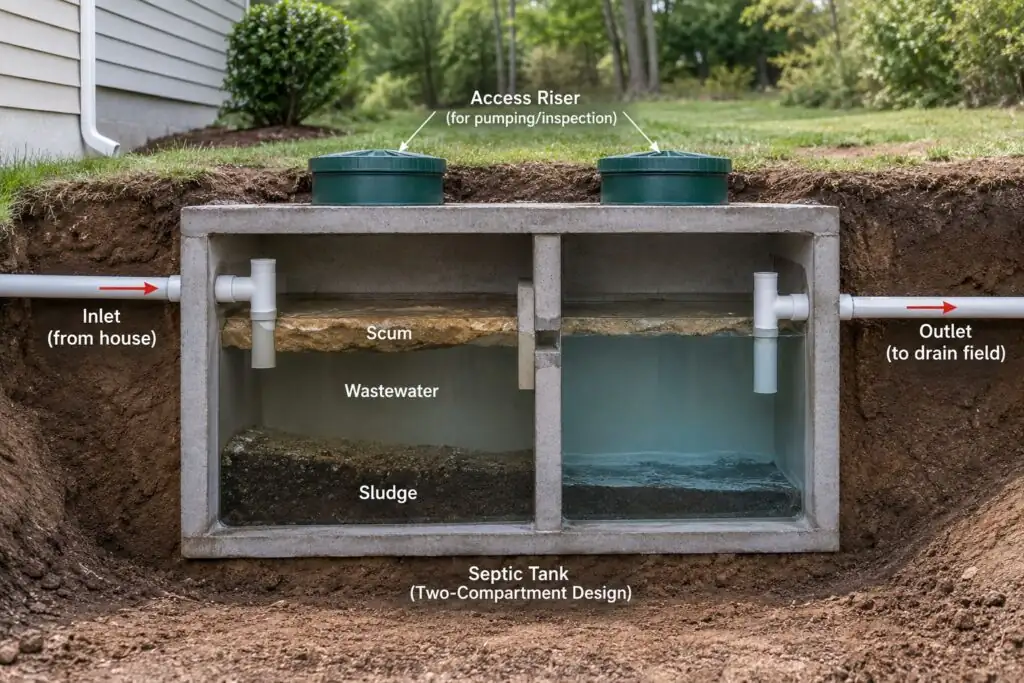
Why this matters to your wallet
- Easements can remove the best half of a property from consideration
- Sandy soil can permit a cheaper system — if the evaluation supports it
- Well separation distances are rarely negotiable
- Locating an undocumented system costs less than digging for it
Local Ground Conditions
Why Rusk County Property Is Its Own Problem
Rusk County sits further north than the rest of our area and it behaves differently. These are the conditions that actually decide what can be built on a property here.
Sandier ground than the Lufkin claypan
Much of Rusk County carries deep sandy and loamy soils rather than the abrupt claypan that dominates around Lufkin. Where those soils are deep and well drained, a conventional gravity drainfield becomes a realistic option — cheaper to install, cheaper to own, and with nothing to break. That is worth knowing, because a contractor who quotes an aerobic unit as a matter of course may simply be applying a different county’s answer to your property.
Free-draining is not automatically suitable
Coarse sand takes water readily and filters it poorly. A system that disposes of effluent faster than the soil can treat it is a groundwater problem rather than a solution, which matters a great deal in a county where most rural households drink from a private well. A proper evaluation examines depth to any restrictive horizon and to the seasonal high water table, not just how fast a test hole drains. Soil can be too permeable as easily as too tight.
A century of easements across the county
This is the East Texas Oil Field. Gathering lines, transmission pipelines, tank batteries, power corridors and road easements cross an enormous number of rural tracts here, and a great many of them are older than the houses. You cannot lay a drainfield across a pipeline easement, and you should not want to. Establishing where those run before designing a system — rather than after a locate request comes back — is the difference between a straightforward job and a redesign.
Lake lots and creek bottoms
Martin Creek Lake, the Lake Cherokee shoreline and the Sabine River bottoms give parts of the county a very different profile from the uplands: smaller lots, tighter setbacks, wetter ground and a seasonal water table that rises into the soil a drainfield depends on. A property a few miles from open water and a property on it can need entirely different systems, and only an evaluation tells you which you have.
Choosing between conventional and aerobic here
In Rusk County the choice is often genuinely open, which makes it worth understanding. A conventional gravity field is cheaper and has no moving parts, but needs suitable soil and enough clear ground. An aerobic treatment unit works on sites a gravity field cannot use and takes far less space, but needs mains power, servicing and a maintenance contract for the life of the system. Our comparison of aerobic vs. conventional septic systems sets the costs and obligations out side by side.
Permits & Rules
Septic Permits and Rules in Rusk County
Rusk County handles on-site sewage facilities through a designated representative at the courthouse rather than a large permitting department. That makes it a more personal process than some counties, and it makes getting your paperwork right the first time more valuable.
Who to deal with in Rusk County
On-site septic inspection for Rusk County is handled by the county’s designated representative, Jeff Harman, working out of the Rusk County Courthouse at 115 N. Main in Henderson. He can be reached on 903-854-2760 at the office or 903-646-2735 on mobile. For anything involving a new system, a replacement or an alteration, that office is where the process starts and where the inspection comes from.
What a new system permit involves
The sequence follows TCEQ rules. A licensed site evaluator or professional engineer assesses the lot and the soil, including depth to any restrictive horizon and to groundwater. Planning materials and the permit application go to the permitting authority, which under state rules has 30 days to approve or deny them. Installation must be carried out by an appropriately licensed installer, and the system is inspected before it is covered. Skipping the inspection is how a system becomes unpermitted, and unpermitted systems surface at closing.
Fees and timelines
Rusk County does not publish a fee schedule as prominently as some neighbouring counties, so rather than quote a figure that may be out of date we confirm the current fees directly with the county before we give you a price. What is fixed by state rule is the 30-day window the authority has to approve or deny an application, and the requirement that the work be done by licensed people and inspected before it is buried. Build the permit timeline into your schedule rather than discovering it once the excavator is booked.
Easements and title work come first
This is the Rusk County-specific step that other counties do not need as often. Before a design is worth drawing, we want to know where the pipeline, utility and access easements run, where the water well sits, and where the property lines actually are. In a county this heavily crossed by oilfield infrastructure, a system designed without that information stands a real chance of having to be redesigned. Your survey and title documents usually answer it in ten minutes.
Aerobic systems: contracts and inspections
Any aerobic treatment unit in Texas must be maintained under contract with a licensed provider, with inspections every four months, and the obligation follows the property rather than the owner. On rural acreage where nobody is watching the control panel, that contract is the only thing likely to catch a failed compressor before the spray field shows it. It is also the item most likely to be found lapsed during a sale. Our guide to septic inspections before buying a home covers what to check.
Buying rural property in Rusk County
Get the system inspected during the option period, and read the easements at the same time. The questions that matter here are whether the existing system is permitted and documented, whether it meets current separation distances from the well and the boundaries, and whether a replacement could legally be sited on the tract if this one failed. On heavily encumbered acreage the last question occasionally has an uncomfortable answer, and it is far better to have it before closing.
For a fuller walk-through of how Texas OSSF permitting works, read our guide to septic permits in East Texas.
Why Us
Why Rusk County Property Owners Call Elite Septic Service
10 years on East Texas systems
We have worked on septic systems across this region for 10 years — sandy uplands, claypan, creek bottoms and acreage where the only clear ground was already spoken for. Recognising a drainfield six months from failing takes that kind of time behind you.
We read the easements before we design
In oilfield country that is not optional. Knowing where the pipelines, corridors and access easements run before drawing a system is the difference between a design that gets approved and one that gets redone at your expense.
Licensed, insured and permitted properly
Licensed installers, full insurance, and permits filed with the county the way the rules require. Unpermitted work becomes the seller's problem at closing, and we have been called in to unpick enough of it to take this seriously.
Flat-rate, with the distance included
You get the price before the work and it does not climb because the job was further out than we expected. If something genuinely unexpected turns up underground we stop and talk to you rather than adding a line to the invoice.
We will say when a repair is not worth it
A patch on a field that has already failed is money spent twice. Where the easements mean the replacement has to go somewhere else entirely, you need to know that before paying for a repair that only postpones it.
Honest about how far away we are
Rusk County is the northern end of our area. We cover it, we do not charge extra for the distance, and when you call with an emergency we will tell you realistically when we can be there rather than promising an hour we cannot make.

Questions worth asking any Rusk County septic company
- Are you licensed by TCEQ, and can you show it?
- Have you checked the easements before designing the field?
- How far is the field from my water well?
- Will a conventional system work here, or only an aerobic one?
- Will you open the tank, or only look at the yard?
- Who files the county permit and requests the inspection?
- What happens if the problem comes back?
Any contractor worth hiring answers all seven before taking a deposit. The easement question in particular separates people who have worked this county from people who have not. There is more about the crew on our about page.
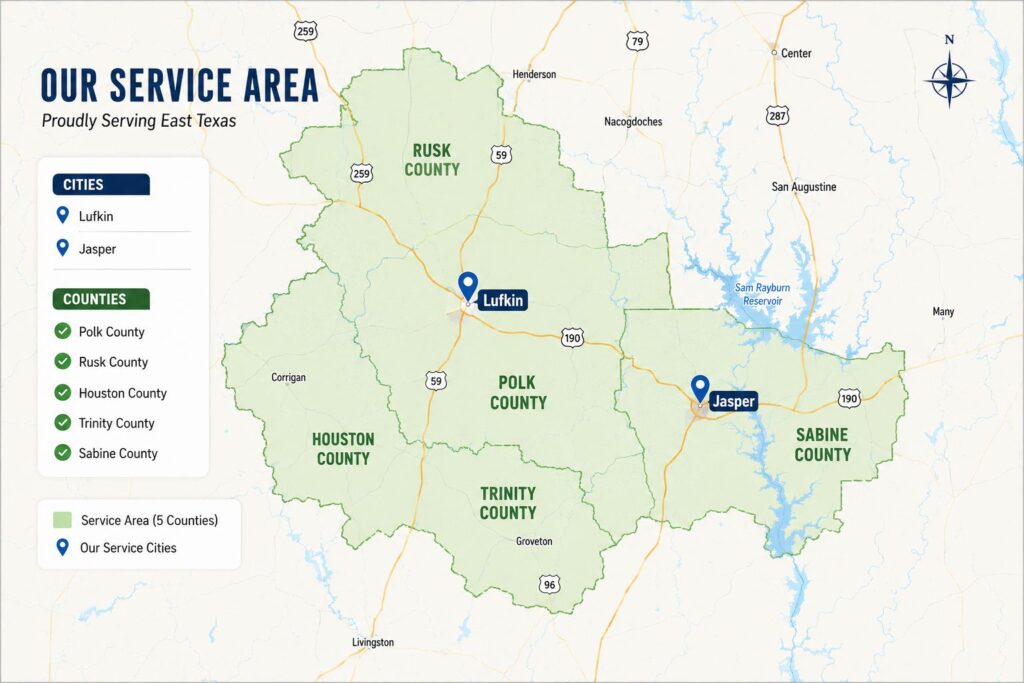
Service Area
The Rusk County Area We Cover
Henderson has municipal sewer across much of town, so the septic work sits in the outer neighbourhoods, the smaller communities and the rural acreage that makes up most of the county.
- Henderson and the surrounding acreage
- Overton, Tatum and New London
- Mount Enterprise, Laneville and Price
- Martin Creek Lake and the Lake Cherokee area
- The Sabine River bottoms
- Rusk County in full
- Angelina, Houston, Trinity, Polk, Jasper and Sabine counties
Mount Enterprise, Laneville or a county road outside Tatum — the price is the same as in Henderson. If you are not sure your address is inside the area, ring us and read out the road name. You can see the wider coverage on our service areas page. We also cover Lufkin and Angelina County to the south and Houston County to the southwest.
Septic Service FAQs for Rusk County, TX
Common questions from homeowners, landowners and buyers across Rusk County. If yours is not here, call and ask.
How much does septic service cost in Rusk County?
Who issues septic permits in Rusk County?
Can a pipeline easement stop me putting in a septic system?
Can I use a conventional system in Rusk County, or do I need aerobic?
How far does a drainfield have to be from my water well?
How often should a septic tank be pumped in Rusk County?
Do you offer emergency septic service in Rusk County?
I am buying rural property in Rusk County. What should I check?
What areas of Rusk County do you serve?
How do I book septic service in Rusk County?
Need Septic Service in Rusk County, TX?
Tell us the address and what is happening — a backup, a smell, an alarm, a land purchase or a new build. We will check what the tract will actually support once the easements and the well are accounted for, give you a free estimate, and agree the price before any work starts.
- Free estimates and flat-rate pricing agreed up front
- Licensed, insured and based in East Texas
- No travel surcharge for being at the north end of our area