
Serving Livingston & Polk County
Septic Service in Polk County, TX
Elite Septic Service installs, repairs, inspects and maintains septic systems for homes, lake places and businesses across Polk County. We work the subdivisions around Lake Livingston and the acreage out toward Corrigan and Camden, we know the county’s minimum lot-size rules before we design anything, and we answer the phone when a tank backs up on a Sunday night.
- 10 years on East Texas septic systems
- Free estimates and flat-rate pricing agreed up front
- 24/7 emergency response across Polk County

Local Septic Contractor
A Septic Company That Understands Lake Livingston Lots
Polk County has a septic problem that most East Texas counties do not: an enormous number of small platted lots. The subdivisions that went in around Lake Livingston from the 1960s onward carved the shoreline and the land behind it into parcels sized for a weekend cabin, not for a permanent house with three bathrooms and a washing machine. Decades later those cabins have become retirement homes, and the systems underneath them are being asked to do something they were never designed for on lots that cannot easily hold a bigger field.
That is why lot size dominates the conversation here. Polk County requires a minimum of half an acre where the property is on central water, and a full acre where it has a private well — and on a platted lakefront lot those numbers decide whether anything can be permitted at all. We would rather establish that on day one than after somebody has paid for a design.
What working in Polk County actually changes
It changes the first question we ask, which is how big the lot is and whether the water is central or a well. It changes system selection, because a small lot with tight setbacks usually points toward an aerobic unit with spray or drip dispersal rather than a conventional field. It changes how we plan around the Trinity River bottoms and the flood-prone ground near the lake. And it changes the paperwork, because Polk County runs its own permitting office rather than sending you to a river authority.
What you get on every Polk County call
- A licensed, insured crew that works these lake subdivisions weekly
- Lot size and water source established before a design is drawn
- A free estimate, and the county fee shown separately in it
- Photographs of what we found, not just a verbal summary
- The county permit filed and the inspection requested by us
- Round-the-clock response for backups, overflows and alarms
Services in Polk County
Septic Services We Provide in Polk County, TX
Everything we do is available anywhere in Polk County — Livingston, the lake subdivisions and the acreage beyond — with no travel surcharge for being out of town.
Septic Tank Installation
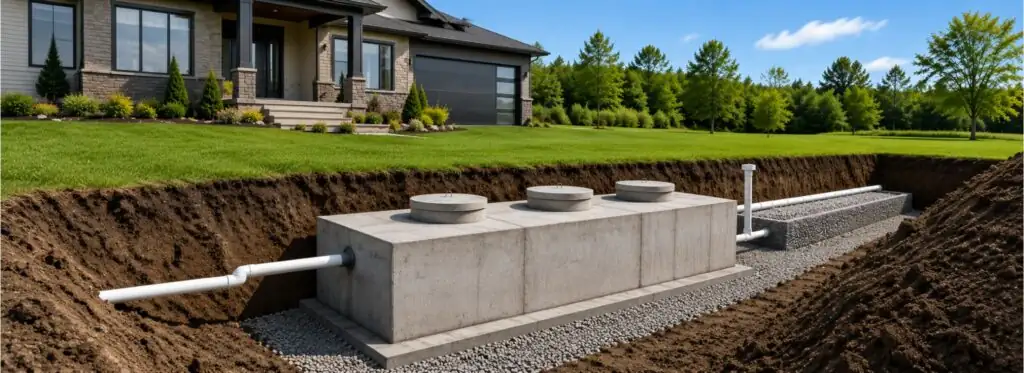
New conventional and aerobic systems for houses, cabins, shops and new builds. On a Polk County lot the design starts with what will physically and legally fit: half an acre minimum on central water, a full acre on a private well, and setbacks that a narrow lakefront parcel often cannot spare.
Septic Tank Repair
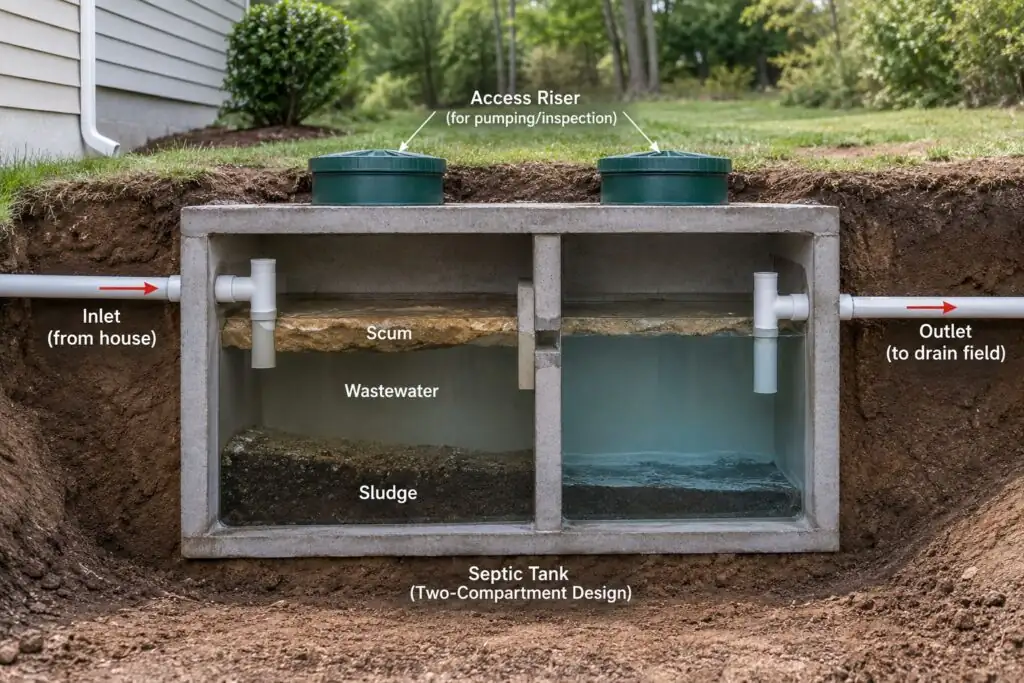
Cracked tanks and lids, failed baffles and tees, broken inlet and outlet lines, collapsed distribution boxes, effluent pumps, floats and alarms. Spray systems are common here, which means pumps, timers and control panels are a bigger share of what actually fails.
Septic Inspections
Real-estate and routine inspections with a written report and photographs. Lake Livingston property turns over constantly and a great deal of it is older than the current rules, so knowing what is buried — and whether it could be replaced legally if it failed — matters more here than almost anywhere.
Septic System Replacement
When a system is finished, we design and install its replacement, decommission the old tank properly, and size the new one for how the place is used now. On a small lot that often means an aerobic unit, because there is simply nowhere to put a conventional field.
Emergency Septic Service
Backups into the house, sewage surfacing in the yard, alarms that will not clear and tanks overflowing after heavy rain. Available 24 hours a day across Polk County, including the lake subdivisions where neighbours are close and a surfacing problem does not stay private.
Pumping & Maintenance
Routine pump-outs, filter cleaning, aerobic maintenance visits and the four-monthly inspections Texas requires on aerobic units. Polk County also charges a small processing fee for filing a maintenance contract, and we handle that paperwork rather than leaving it to you.
Drain Cleaning
Slow drains, recurring clogs and lines that back up before the tank does. We check the tank first, because on a property where the system is already marginal a blocked line and a full tank produce identical symptoms indoors.
Sewer Line Repair
Cracked, offset, root-invaded and crushed lines between the house and the tank — repaired or replaced, with the yard put back rather than left as a trench. On a tight lakefront lot, keeping the excavation small is not a nicety, it is the whole job.
Sewer Camera Inspection
A camera down the line locates the break, the belly or the root intrusion precisely. On older lake cabins where the plumbing has been added to piecemeal over fifty years, tracing what actually runs where is usually the first useful step.
Around Lake Livingston and Onalaska, the most common requests are aerobic system maintenance for lake homes and septic inspections for property sales. Tight subdivision lots often need a replacement system designed around the minimum lot size, while acreage builds out toward Corrigan need new septic installation. We also handle tank repairs, broken sewer lines, camera inspections of the line and drain cleaning for slow or backing-up drains, with 24/7 emergency response anywhere in Polk County. Or browse the full list of our septic services.
Common Problems
Common Septic Problems We See in Polk County
These are the calls that come in week after week from Polk County addresses. Most of them trace back to the same root cause: small lots carrying more house, and more people, than the original system was built for.
Cabins that became full-time homes
A weekend cabin on a quarter-acre gets a second bathroom, a dishwasher and two permanent residents. Nothing about the system changed, but daily flow doubled or tripled, and the drainfield had no reserve capacity to give.
Spray heads that stopped spraying
Aerobic systems are common on Polk County lots because conventional fields often will not fit. That means pumps, timers, chlorinators and spray heads — all of which fail, usually quietly, and usually without anything backing up until the problem is well advanced.
Lots that cannot legally hold a replacement
The hardest conversation we have here. A system fails on a small platted lot, and the replacement has to meet current minimum acreage and setback requirements that the original never had to. Finding this out during a sale is far better than finding it out after.
Neighbours too close for comfort
In a dense lake subdivision, your drainfield, your neighbour's well and the property line are all competing for the same ground. Setback distances that are trivial on ten acres become the binding constraint on a platted lot, and they are not negotiable.
High water table near the lake and the river
Ground close to Lake Livingston and along the Trinity bottoms can sit wet for long stretches. A drainfield needs unsaturated soil beneath it to work; when the water table rises into that zone, the field stops absorbing regardless of how well it was built.
Pumping that only buys a fortnight
On a small lot the tank refills quickly, so a blinded field shows up fast. Two clear weeks after a pump-out followed by the same backup means the field, not the tank, is what has stopped working.
Maintenance contracts nobody renewed
Texas requires an active contract and four-monthly inspections on aerobic units, and Polk County processes those contracts. A lapsed one is why the compressor that died in March went unnoticed until June.
Systems shared or crossing boundaries
Older subdivisions occasionally have tanks, lines or fields sitting on the wrong side of a property line, put in before anyone was surveying carefully. It is generally discovered at a sale, and it is always more complicated than it first appears.
No records on a fifty-year-old cabin
Common right around the lake. Nobody knows the tank size, the system type or where the field runs, so locating and documenting it is the first job rather than something we guess at from the yard.
If any of that sounds like your property, an inspection will tell you which one it is before you spend anything. You can also read our guide to the seven warning signs a septic system is failing and why drainfields fail.
Why this matters to your wallet
- Lot size decides what can be permitted — check it before you buy
- Aerobic units cost more to own but fit where fields cannot
- A lapsed maintenance contract stalls closings
- Wet ground near the lake is the honest test of any field
Local Ground Conditions
Why Polk County Lots Are Hard on Septic Systems
The constraints here are as much about geometry and water as about soil chemistry. These are the conditions that actually decide what can be built on a Polk County property.
Minimum acreage is a real limit, not a guideline
Polk County requires at least half an acre for an on-site system where the property is served by central water, and at least one acre where it relies on a private well. On the small platted lots that make up much of the lake area, that single rule determines whether a property can support a house at all — and it is the first thing we check, because no amount of clever design gets around it. The first residential structure on a tract of ten acres or more is exempt from the permit fee, though the installation standards still apply in full.
Two different landscapes in one county
Polk County runs from the Trinity River and Lake Livingston on its western side up into the Piney Woods and the edge of the Big Thicket. The uplands carry sandier, better-draining soil where a conventional gravity field can work given enough room. The bottoms and the ground near the lake are a different proposition: heavier, wetter, slower, and subject to a seasonal water table that rises into the soil a drainfield depends on. Two properties a few miles apart can need entirely different systems.
Around fifty inches of rain, and a very large lake
This part of Texas takes roughly fifty inches of rain a year, weighted toward the cooler months. Lake Livingston is one of the largest reservoirs in the state and it dominates the county’s drainage; ground near the shoreline and along the feeder creeks holds water long after the rain stops. Drainfields that cope comfortably in August are the ones that surface in January, and the first sustained wet spell each year produces a run of emergency calls from exactly these addresses.
Density changes the risk
A failing system on ten acres is your problem. A failing system on a quarter-acre lot in a subdivision is everybody’s, and it is far more likely to be reported. Surfacing effluent, odour and spray drift all carry further than people expect, and in a dense lake community the practical consequence of a marginal system is a complaint rather than a slow decline nobody notices. That is an argument for maintenance rather than for luck.
Why aerobic systems are so common around the lake
Because an aerobic treatment unit treats the wastewater before dispersing it, which means it needs far less land and tolerates ground a conventional field cannot use. On a small lot with tight setbacks it is frequently the only permittable option. The trade-off is genuine: moving parts, mains power, a maintenance contract and four-monthly inspections for the life of the system. If you are weighing the two, our comparison of aerobic vs. conventional septic systems sets out the costs and obligations side by side.
Permits & Rules
Septic Permits and Rules in Polk County
Polk County is refreshingly straightforward compared with some of its neighbours: the county runs its own permitting office, the fees are published, and you deal with one authority rather than working out whether a river authority has jurisdiction.
The county issues the permit
On-site sewage facility permits in Polk County are handled by the county’s Permits Department at 602 E. Church Street, Suite 141 in Livingston, reachable on 936-327-6820 extension 1 or at permits@co.polk.tx.us, open Monday to Friday from 8am to 4pm. That is one office for the whole county, which makes the process considerably simpler to plan around than in counties where jurisdiction depends on how close you are to a reservoir.
What a new system permit involves
A site and soil evaluation has to be prepared by a Site & Soil Evaluator, Registered Sanitarian or Professional Engineer licensed by TCEQ — the county will not accept an assessment from anyone else. That evaluation, the system design, the application and the fee go in together. Under TCEQ rules the permitting authority has 30 days to approve or deny planning materials and the application, installation must be done by an appropriately licensed installer, and the system is inspected before it is covered.
What it costs
Polk County’s published schedule puts a residential permit at $300 and a residential repair permit at $150. Commercial permits are $400, commercial repairs $200, and processing a maintenance contract is $15. The first residential structure on a tract of ten acres or more is exempt from the permit fee, although every installation standard still applies. Fees do change — we confirm the current schedule with the county before we quote, and you should expect any contractor to do the same.
Minimum lot size is the rule that catches people
At least half an acre is required where the property is on central water, and at least one acre where it has a private well. On the small platted lots around Lake Livingston this is frequently the binding constraint, and it applies to replacements as well as new builds. If you are buying a lot with the intention of putting a house on it, establish this before you sign rather than after — a lot that cannot support a permittable system is worth a great deal less than one that can.
Aerobic systems: contracts and inspections
Aerobic units require a maintenance contract with a licensed provider and regular inspections under county and state rules, with Polk County charging a processing fee to file the contract. Because aerobic systems are so common on the smaller lots here, this obligation affects a large share of county properties — and a lapsed contract is one of the most reliable ways to derail a closing. Our guide to septic inspections before buying a home covers what to check.
Buying near Lake Livingston
Get the system inspected during the option period. On lake property the questions are specific: how big is the lot, is it on central water or a well, does the existing system meet current setbacks, is there an active maintenance contract, and — the one people forget — could this system legally be replaced if it failed next year? Ask them before closing, because every one of them is negotiable then and nobody’s problem but yours afterwards.
For a fuller walk-through of how Texas OSSF permitting works, read our guide to septic permits in East Texas.
Why Us
Why Polk County Property Owners Call Elite Septic Service
10 years on East Texas systems
We have worked on septic systems across this region for 10 years — sandy uplands, river bottoms, tight subdivision lots and acreage where nothing wanted to fit. Recognising a drainfield six months from failing takes that kind of time behind you.
We check what will fit before we design
Lot size, water source and setbacks come first on a Polk County job, not after a design has been drawn. It is the quickest way to find out whether the system somebody wants is the system the property can actually have.
Licensed, insured and permitted properly
Licensed installers, full insurance, and permits filed through the county the way the rules require. Unpermitted work becomes the seller's problem at closing, and we have been called in to unpick enough of it to take this seriously.
The county fee is in the estimate
Polk County publishes its permit fees, so there is no reason for them to be a surprise. You see the work price and the county price separately, before anything starts, and neither moves once the excavator arrives.
We will tell you if the lot is the problem
Sometimes the honest answer on a small platted lot is that no system can be permitted there, or that the repair you want will not solve what is actually wrong. You will hear that from us before you spend, not after.
24/7 when it actually matters
Septic emergencies do not keep business hours, and in a dense lake subdivision they do not stay private either. We run emergency response around the clock across Polk County and the surrounding counties.

Questions worth asking any Polk County septic company
- Are you licensed by TCEQ, and can you show it?
- Does my lot meet the county minimum for the system you are proposing?
- Who files the county permit — you or me?
- Is the estimate flat-rate or an hourly starting point?
- Will you open the tank, or only look at the yard?
- Who handles the aerobic maintenance contract afterwards?
- What happens if the problem comes back?
Any contractor worth hiring will answer all seven before taking a deposit. If you get vague answers on the lot-size question in particular, keep calling. There is more about the crew on our about page.
Service Area
The Polk County Area We Cover
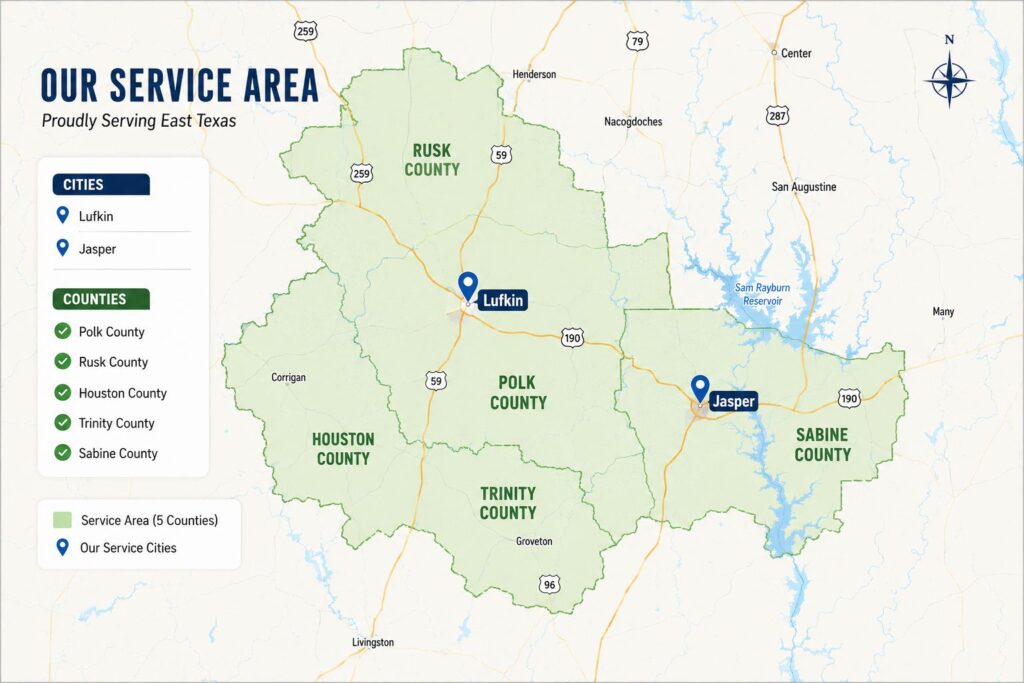
Livingston has municipal sewer across much of town, so the septic work concentrates in the lake subdivisions, the smaller communities and the acreage in between — which is exactly where the lot-size and water-table problems live.
- Livingston and the surrounding acreage
- Onalaska and the Lake Livingston subdivisions
- Corrigan, Goodrich and Seven Oaks
- Leggett, Camden and Moscow
- The Trinity River bottoms and feeder creeks
- Polk County in full
- Angelina, Trinity, Houston, Jasper, Rusk and Sabine counties
Onalaska, Corrigan or a road off FM 3277 — the price is the same as in town. If you are not sure your address is inside the area, ring us and read out the road name. You can see the wider coverage on our service areas page. Nearby, our crews also cover Trinity County and Lufkin and Angelina County.
Septic Service FAQs for Polk County, TX
Common questions from homeowners, lake property owners and buyers across Polk County. If yours is not here, call and ask.
How much does septic service cost in Polk County?
Who issues septic permits in Polk County?
How much land do I need for a septic system in Polk County?
Do I need an aerobic system, or will a conventional one work?
Why does my system only give trouble in winter?
Do you offer emergency septic service in Polk County?
I am buying a cabin at Lake Livingston. What should I check?
My aerobic system smells or the spray heads have stopped. What now?
What areas of Polk County do you serve?
How do I book septic service in Polk County?
Need Septic Service in Polk County, TX?
Tell us the address and what is happening — a backup, a smell, an alarm, a lake purchase or a new build. We will tell you whether it needs someone today or an appointment this week, check what the lot will actually support, give you a free estimate, and agree the price before any work starts.
- Free estimates and flat-rate pricing agreed up front
- Licensed, insured and based in East Texas
- 24/7 emergency response across Polk County