
Scheduled Septic System Maintenance
Septic System Maintenance in Lufkin, TX
A septic system that is looked after quietly does its job for decades. One that is left alone until something goes wrong takes the drainfield down with it. Elite Septic Service handles pumping, filter cleaning, component testing and aerobic maintenance contracts across Lufkin, Angelina County and the surrounding East Texas counties — on a schedule, so it does not depend on anyone remembering.
- Pumping, servicing and aerobic maintenance contracts in one place
- Scheduled visits with reminders, so nothing quietly lapses
- Free estimates and flat-rate pricing agreed up front

Maintenance Overview
Why Septic Maintenance Costs Far Less Than the Alternative
Everything expensive about a septic system happens in the drainfield, and almost everything that kills a drainfield starts in the tank. A tank works by letting solids settle to the bottom and grease float to the top, so that only the clear layer in the middle leaves for the field. When sludge builds up to the level of the outlet, or an effluent filter clogs, or a baffle breaks off, solids start going out with the effluent. The soil in the trenches clogs, and clogged soil does not recover.
That is the whole argument for maintenance. Pumping a tank on a sensible interval is a routine cost. Replacing a drainfield is one of the largest bills a rural property can hand its owner. The gap between those two numbers is what a maintenance schedule buys you.
What regular maintenance actually prevents
Routine servicing catches the things that have no symptoms until they have already done damage: a filter blinding over, an outlet baffle that has corroded away, a float switch that has stopped moving, an air compressor that quit six weeks ago on an aerobic unit. None of those announce themselves. All of them are cheap to put right on a scheduled visit and expensive to discover through a backup.
Elite Septic Service has worked on East Texas septic systems for 10 years, and the crew that services them is the crew that repairs and replaces them. That matters, because knowing what a system looks like shortly before it fails is not something a checklist teaches.
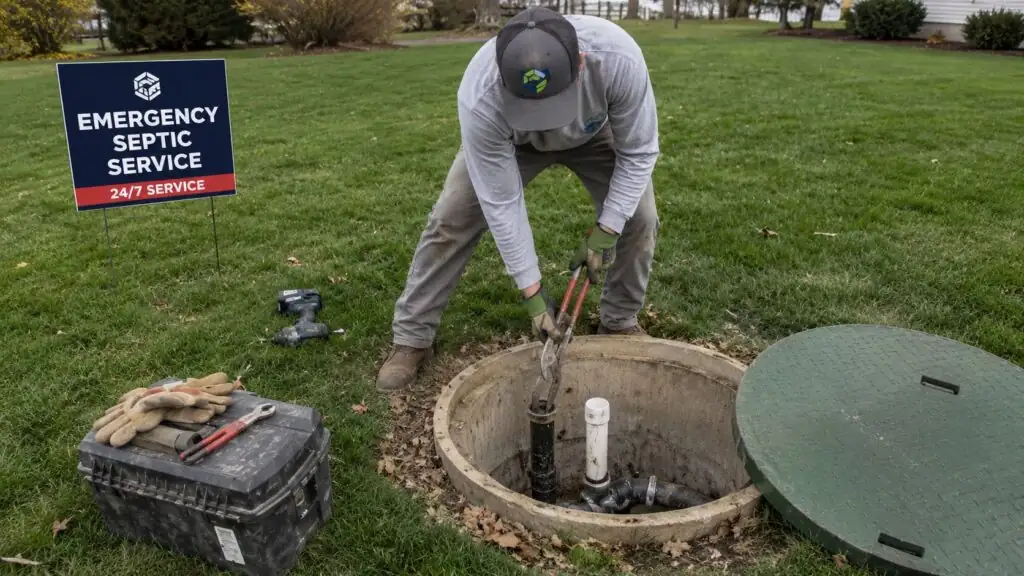
What a maintenance visit includes
- Sludge and scum depths measured against the tank outlet, not estimated
- Inlet and outlet baffles or tees checked for damage and displacement
- The effluent filter pulled, cleaned and refitted where one is present
- Pumps, floats, alarms and control panels tested under real conditions
- The drainfield walked for saturation, ponding and surfacing effluent
- A written record of what was done and when the next visit is due
What We Service
What Our Septic Maintenance Covers
Maintenance is not one task. Depending on the system you own, some or all of these are part of keeping it healthy.
Septic Tank Pumping
The core of any maintenance schedule. The tank is pumped down so accumulated sludge and grease leave the property rather than the outlet, and we pump the full tank rather than skimming the liquid layer off the top.
Sludge and Scum Measurement
Depths are measured against the outlet rather than guessed at. That is what sets a sensible pumping interval for your household instead of a generic number, and it is how we spot a tank filling faster than it should.
Effluent Filter Cleaning
Where a system has an outlet filter, it is the last thing standing between solids and the drainfield — and it blinds over. Pulled, washed back into the tank and refitted, typically at every pump-out or annually.
Baffle and Tee Inspection
The inlet baffle slows incoming flow so solids can settle; the outlet baffle keeps them from escaping. Both corrode and break away, and a missing outlet baffle is one of the most common faults we find on older tanks.
Aerobic Maintenance Contracts
Texas requires aerobic treatment units to be kept under an active maintenance contract with regular inspections by a licensed provider. We hold the contract, carry out the visits, and keep the reporting straight so yours does not lapse.
Pump, Float and Alarm Testing
Effluent pumps, lift pumps, float switches and high-water alarms fail silently. We run them, watch them cycle, and confirm the alarm actually sounds rather than assuming the wiring still does what it did five years ago.
Aerator and Air Compressor Service
On an aerobic unit the compressor is what keeps the treatment bacteria alive. Filters get cleaned or replaced, output is checked, and a compressor that has stopped is caught on a visit rather than through the smell.
Chlorinator and Spray Head Service
Disinfection tablets checked and topped up, the chlorinator tube cleared, and spray heads or drip lines checked for blockage and correct coverage so effluent is being dispersed where the design intended.
Drainfield Monitoring
The field is walked on every visit for soft ground, ponding, surfacing effluent and the stripe of faster grass that shows effluent sitting too high. Catching that early is the difference between adjusting habits and rebuilding a field.
Lids, Risers and Access
A tank nobody can reach is a tank nobody pumps. We check lids and risers for cracks and safe seating, and where access has been buried or sealed over we can fit risers so future servicing does not start with a shovel.
If maintenance turns up something that needs putting right, we handle it: septic tank repair, septic system replacement, and 24/7 emergency septic service across East Texas.
Step By Step
How a Septic Maintenance Visit Works
Every visit follows the same order, so nothing gets skipped because the tank looked fine from the top.
1. Schedule the Visit
Tell us the address, the system type if you know it, and roughly when it was last serviced. We set a date and, once you are on a schedule, we contact you when the next one is due rather than waiting for you to remember.
2. Locate and Open the System
Lids and risers are located and opened. On properties where access has been buried or paved over, uncovering it is part of the visit — and usually the point at which we suggest fitting risers so the next one is simpler.
3. Measure Before Anything Is Pumped
Sludge and scum depths are measured against the outlet first. Pumping erases the evidence, so measuring beforehand is what tells us whether your interval is right, too long, or whether something is filling the tank faster than it should.
4. Pump and Clean
The tank is pumped out fully rather than skimmed, the effluent filter is pulled and washed back where one is fitted, and the inlet and outlet baffles are inspected once the tank is empty enough to see them properly.
5. Test Components and Walk the Field
Pumps, floats, alarms, control panels, compressors, chlorinators and spray heads are tested wherever the system has them. Then the drainfield is walked for saturation, ponding, surfacing and root intrusion.
6. Record It and Set the Next Date
You get a written record of what was measured, what was done and what to watch, plus a realistic interval for the next visit based on your tank size and household rather than a generic figure.
How often should a septic system be serviced?
For a conventional tank and drainfield system, pumping every three to five years alongside an inspection is the sensible rhythm, with the exact interval set by tank capacity and how many people live in the house. A four-person household on a 1,000 gallon tank needs it more often than a couple on a 1,500 gallon tank. Aerobic systems are on a much tighter schedule: Texas requires units using secondary treatment or drip irrigation to be inspected by a licensed maintenance provider every four months, under an active maintenance contract. Beyond any schedule, a change in how the system behaves is always a reason to bring a visit forward.
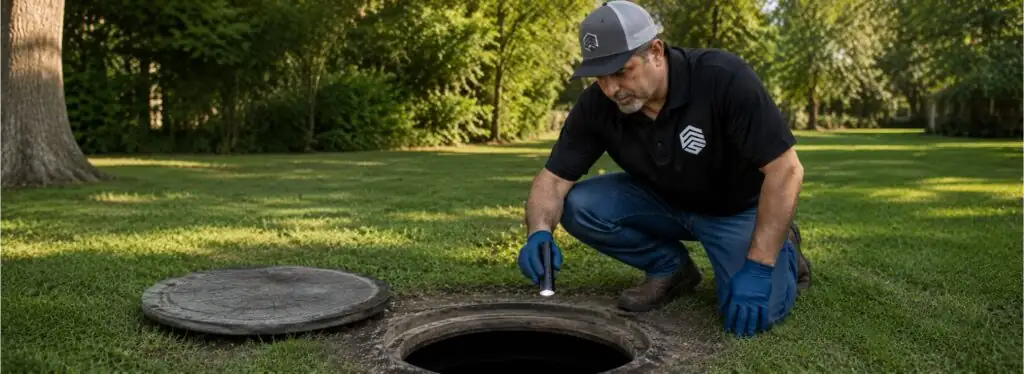
What Shortens a Septic System Life
Maintenance is half servicing and half habits. These are the things that quietly take years off a system:
- Wipes, paper towels, cat litter and hygiene products going down the toilet
- Cooking grease poured down the sink, where it hardens in the tank
- Drain chemicals and bleach in volume, which kill the bacteria doing the work
- A garbage disposal in heavy use, which roughly doubles the solids load
- Laundry run as several loads back to back rather than spread out
- Vehicles, trailers or livestock driven and parked over the drainfield
- Trees and shrubs planted close enough for roots to reach the trenches
None of these cause a failure on their own. Together, over years, they are the difference between a drainfield that lasts thirty years and one that lasts twelve.
System Types
Maintenance by System Type
What your system needs depends on what it is. Here is how the schedule differs across the systems we see most around Lufkin.
Conventional tank and drainfield
The simplest system to own. It wants pumping every three to five years with sludge and scum measured, baffles checked, the effluent filter cleaned if one is fitted, and the field kept clear of vehicles and deep-rooted planting. There is nothing electrical to fail, which is exactly why it is the least demanding option where soil allows it.
Aerobic treatment units
Common across East Texas because of the clay, and a genuinely different commitment. Texas requires an active maintenance contract with inspections every four months by a licensed provider. Each visit covers the air compressor, the pump, floats, alarm, control panel, chlorine supply and dispersal components, along with the tank itself.
Spray and drip dispersal fields
Spray heads block, drip lines clog, and coverage drifts from what the design intended. Servicing includes checking heads and lines, confirming the chlorinator is dosing, and looking at where effluent is actually landing rather than where the drawing says it should.
Pumped and low-pressure systems
Any system where effluent has to be lifted rather than allowed to run adds a pump tank, floats, a control panel and an alarm. Those are the components that fail without warning, so testing them is the point of the visit as much as pumping the tank is.
Older and undocumented systems
On rural tracts around Angelina and the neighbouring counties, plenty of systems predate reliable records. The first visit is partly detective work: finding the tank and the field, establishing the type and rough age, and working out whether the layout matches whatever paperwork exists.
Rentals, second homes and light-use properties
Low or intermittent use is not the same as no maintenance. Tanks still accumulate, baffles still corrode, and a system that sits unused for months can have its bacterial balance disrupted. Landlords also carry the compliance side, which is worth having handled on a schedule rather than at a tenant changeover.
Do and Do Not
Looking After a Septic System Between Visits
Most of what determines how long a system lasts happens between our visits, in the ordinary running of the house. None of it is complicated.
Habits that extend a system life
- Spread laundry across the week rather than several loads in one day
- Fix dripping taps and running toilets, which quietly flood a drainfield
- Fit low-flow fixtures where it is easy to do so
- Keep the drainfield clear of vehicles, trailers, sheds and livestock
- Direct roof and surface runoff away from the field, not across it
- Keep records of every pump-out, service and repair in one place
- Know where your tank lids and drainfield are, and keep access clear
Things that shorten it
- Flushing wipes, even the ones sold as flushable, along with paper towels
- Pouring cooking grease or fat down any drain in the house
- Using drain chemicals or bleach in quantity, which kills the bacteria
- Running a garbage disposal heavily, roughly doubling the solids load
- Putting off a pump-out because nothing appears to be wrong
- Planting trees or shrubs near enough for roots to find the trenches
- Ignoring a sounding alarm, a slow drain or a soft patch in the yard
Why Us
Why Choose Elite Septic Service for Septic Maintenance
10 Years in East Texas
We have worked on septic systems in this part of Texas for 10 years, on sandy loam and on heavy clay. Recognising a system that is drifting toward trouble takes that kind of time behind you.
We Measure Before We Pump
Sludge and scum depths are recorded against the outlet before the tank is emptied. That is how your pumping interval gets set to your household rather than to a generic number that suits the truck schedule.
Scheduled, Not Forgotten
Once you are on a maintenance schedule we contact you when the next visit is due. Systems fail because servicing lapses, and lapses happen when remembering is left to the homeowner.
Aerobic Contracts Handled Properly
Texas requires aerobic units to be kept under an active maintenance contract. We hold the contract, carry out the four-monthly visits and keep the reporting straight, so yours does not quietly expire.
Written Records Every Time
What was measured, what was done, what to watch and when the next visit is due — in writing. It is also exactly what a buyer, a lender or a county agent will ask for later.
We Will Tell You It Can Wait
If the tank does not need pumping yet, we say so and set a date. We would rather come back next year than sell a service that does nothing for the system.
Licensed, Insured and Locally Based
Elite Septic Service is a locally owned, licensed and insured septic contractor with one local crew, free estimates and flat-rate pricing agreed before any work starts.

Questions worth asking any septic maintenance provider
- Do you measure sludge and scum, or pump on a fixed schedule?
- Will you pump the tank fully, or skim the liquid off the top?
- Is the effluent filter cleaned as part of the visit?
- Are the inlet and outlet baffles inspected once the tank is down?
- Does the visit include walking the drainfield?
- Are you licensed to hold an aerobic maintenance contract in Texas?
- Will I get written records I can hand to a buyer or the county?
We answer all seven before we book anything — and you should expect the same from anyone else you call.
Warning Signs
Signs Your System Is Overdue for Maintenance
Maintenance is meant to happen before any of these appear. If one already has, bring the visit forward rather than waiting for the date on the calendar.
You cannot remember the last pump-out
If nobody can say when the tank was last emptied, it is overdue. Three to five years is the usual interval, and tanks do not send reminders when they pass it.
Drains slowing across the whole house
One slow fixture is a clog. Sinks, tubs and toilets all slowing together points at the tank or the line, and it usually arrives a few weeks before something worse.
Gurgling toilets and plumbing
Air pushed back through the traps means the system is not clearing the way it should. It is one of the earliest warnings a septic system gives, and among the easiest to ignore.
Sewage odor around the tank or field
A working system is not something you smell. Persistent odor outdoors points to a lost seal, a broken component, or effluent making its way to the surface.
Soft or spongy ground over the field
Ground that stays wet after the rest of the yard has dried means the soil is no longer absorbing what it is being sent. Worth measuring now, while adjusting the schedule can still help.
Grass growing greener over the trenches
A stripe of thicker, faster grass over the field is being fertilised by effluent sitting too close to the surface. It is the clearest sign visible from the yard and the most commonly missed.
An alarm that has sounded, even once
On an aerobic unit the alarm means high water, a failed pump, a stopped compressor or a tripped breaker. Silencing it is not servicing it, and the tank keeps filling either way.
Your aerobic contract has lapsed
Texas requires aerobic systems to be kept under an active maintenance contract. Owners often find out theirs expired years ago at the worst possible moment, usually during a property sale.
Backups that keep coming back
If the house drains fine for a fortnight after a pump and then backs up again, the problem sits downstream of the tank. That pattern is about the drainfield, and maintenance alone will not fix it.
Not sure whether you need a service visit or something more? A septic inspection will tell you which one it is before you spend anything on the wrong thing.
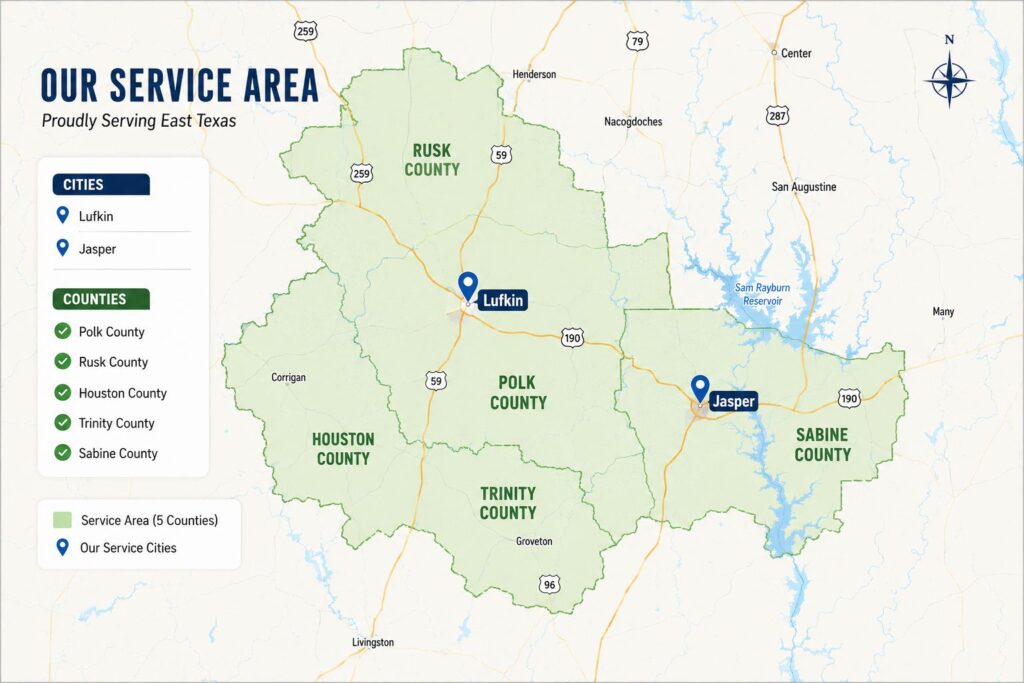
Where We Work
Septic Maintenance Across Lufkin and East Texas
Local ground changes what maintenance has to cover. Much of Angelina County and the counties around it sits on heavy clay that drains slowly, which is why so many properties here run aerobic treatment units rather than conventional gravity fields. That matters for servicing, because an aerobic system brings pumps, floats, alarms, an air compressor, a chlorinator and spray or drip components — and a legal requirement for four-monthly inspections under an active contract. Add pine and hardwood roots heading for the wettest ground on a lot, and long wet spells that keep a marginal field saturated, and the schedule that works here is not the one a generic guide suggests.
Permitting and reporting are local too. On-site sewage facilities in Angelina County are permitted through the Angelina & Neches River Authority in Lufkin, and the neighbouring counties each work through their own authorized agent. We maintain septic systems throughout:
If a service visit turns up something bigger, we can handle it end to end: septic tank repair, septic system replacement, new septic tank installation, a full septic inspection, and 24/7 emergency septic service. See all of our septic services, or check the full East Texas service area if your property is not listed above.
More septic services in Lufkin, TX: septic tank installation, septic tank repair, septic tank inspection, septic system replacement, emergency septic service, drain cleaning, sewer line repair and sewer camera inspection. See everything we offer locally on our septic service in Lufkin, TX page.
Septic Maintenance FAQs
Common questions about maintaining a septic system in Lufkin and across East Texas. If yours is not here, call and ask.
How often should a septic tank be pumped?
For a conventional tank and drainfield system, every three to five years is the usual range, with the exact interval set by tank capacity and how many people live in the house. A four-person household on a 1,000 gallon tank will need it more often than a couple on a 1,500 gallon tank. The only way to set the interval properly is to measure sludge and scum depths against the tank outlet, which is why we measure before we pump rather than working to a fixed calendar. Heavy garbage disposal use, a lot of laundry, or grease going down the sink all shorten it.
What does septic system maintenance include?
At minimum: measuring sludge and scum depths against the outlet, pumping the tank fully, cleaning the effluent filter where one is fitted, and inspecting the inlet and outlet baffles once the tank is down far enough to see them. Beyond that we test any pumps, floats, alarms and control panels the system has, and walk the drainfield for saturation, ponding, surfacing effluent and root intrusion. On aerobic units it also covers the air compressor, chlorinator and spray or drip components. You get a written record and a date for the next visit.
Do aerobic septic systems need a maintenance contract in Texas?
Yes. Texas requires aerobic treatment units and systems using secondary treatment or drip irrigation to be kept under an active maintenance contract with a licensed maintenance provider, with inspections every four months. The provider checks the treatment process, the mechanical components and the disinfection, and reports to the permitting authority. Contracts lapse more often than owners realise, frequently discovered during a property sale. We hold contracts, carry out the visits and keep the reporting current.
What should never go into a septic system?
Wipes of any kind, including ones marketed as flushable, along with paper towels, cat litter, hygiene products, dental floss and cotton buds — none of them break down, and they accumulate as sludge. Cooking grease and fat should never go down a sink, because they harden into the scum layer and can carry through to the field. Avoid drain chemicals, paint, solvents and bleach in quantity, since the tank depends on bacteria that those kill. Medications are also worth keeping out for the same reason.
Does a garbage disposal affect my septic system?
Considerably. Heavy garbage disposal use roughly doubles the volume of solids entering the tank, which means the sludge layer reaches the outlet far sooner and the pumping interval has to shorten to match. It is not a reason to remove one, but if you use a disposal regularly you should expect to pump more often than a neighbour who composts, and you should tell us so we set the interval accordingly rather than assuming standard use.
Do septic additives and treatments work?
A healthy tank already contains the bacteria it needs, supplied continuously by ordinary household waste. Additives sold as a way to avoid pumping do not remove the inorganic solids and grease that accumulate, and some of the harsher chemical products can damage the tank or push solids through to the drainfield. There is no additive that substitutes for pumping. The money is better spent on the schedule.
What can I plant or park over a drainfield?
Grass, and not much else. The field needs oxygen exchange at the surface and undisturbed soil structure underneath, so vehicles, trailers, livestock, sheds, decks and paving all cause damage by compacting the soil. Trees and shrubs are the other problem, because roots head for the wettest ground on a property, which is precisely where your trenches are. Keep deep-rooted planting well clear, and direct roof and surface runoff away from the field rather than across it.
How much does septic maintenance cost?
It depends on the system and the tank. A straightforward pump-out on a conventional system is a routine cost; an aerobic maintenance contract with four-monthly inspections is priced as an ongoing agreement rather than a single visit. Access matters too, since a tank with buried or sealed-over lids takes longer because the access has to be uncovered first. Estimates are free and pricing is flat-rate agreed up front. Set against a drainfield replacement, maintenance is the cheapest money you will spend on a septic system.
Can maintenance fix a failing drainfield?
No, and it is worth being clear about that. Once soil in the trenches has clogged with fine solids it does not recover, so no amount of pumping or servicing brings a failed field back. What maintenance does is stop the field from reaching that point, by keeping solids in the tank where they belong. If your system backs up again within weeks of every pump-out, the field is already the problem and the conversation is about a new drainfield rather than a schedule.
How do I set up septic maintenance in Lufkin?
Call Elite Septic Service at +1 936-208-3153 or send a request through our contact page. Tell us the address, the system type if you know it, and roughly when it was last serviced. We will book the first visit, measure and service the system, and set a realistic interval based on your tank and household. Once you are on a schedule we contact you when the next visit is due, so nothing depends on remembering.
Need Septic Maintenance in Lufkin, TX?
Tell us the address, the system type if you know it, and roughly when it was last serviced. We will book the visit, measure and service the system, walk the drainfield, and give you written records with a realistic date for the next one — no obligation and no pressure to buy work the system does not need.
- Free estimates and flat-rate pricing agreed up front
- Aerobic maintenance contracts held and reported properly
- Licensed, insured and locally based in East Texas