
Licensed & Insured Septic Contractor
Septic Inspection in Lufkin, TX
A clear, documented look at the septic system you already own — or the one you are about to buy. Elite Septic Service inspects tanks, baffles, sludge levels and drainfields across Lufkin, Angelina County and the surrounding East Texas counties, then tells you plainly what condition the system is in and what it needs next.
- 10 years working on East Texas septic systems
- Written findings with photos, not a verbal maybe
- Free estimates and flat-rate pricing agreed up front

Septic Inspection Overview
Why a Septic Inspection Matters for Lufkin Property Owners
Almost everything that matters about a septic system is buried. The tank, the baffles, the distribution line and the drainfield all sit out of sight, and a system can look perfectly normal from the yard right up until the week it stops working. An inspection is how you find out what is actually happening down there before it turns into a repair bill or a stalled closing.
Most of the inspections we run around Lufkin fall into one of three situations. Somebody is buying a property and wants to know what they are inheriting. Somebody is selling and would rather find the problem before a buyer does. Or an owner has noticed something — a slow drain, a soft patch in the yard, an odor after heavy rain — and wants an answer instead of a guess.
What an inspection tells you that a walk-through cannot
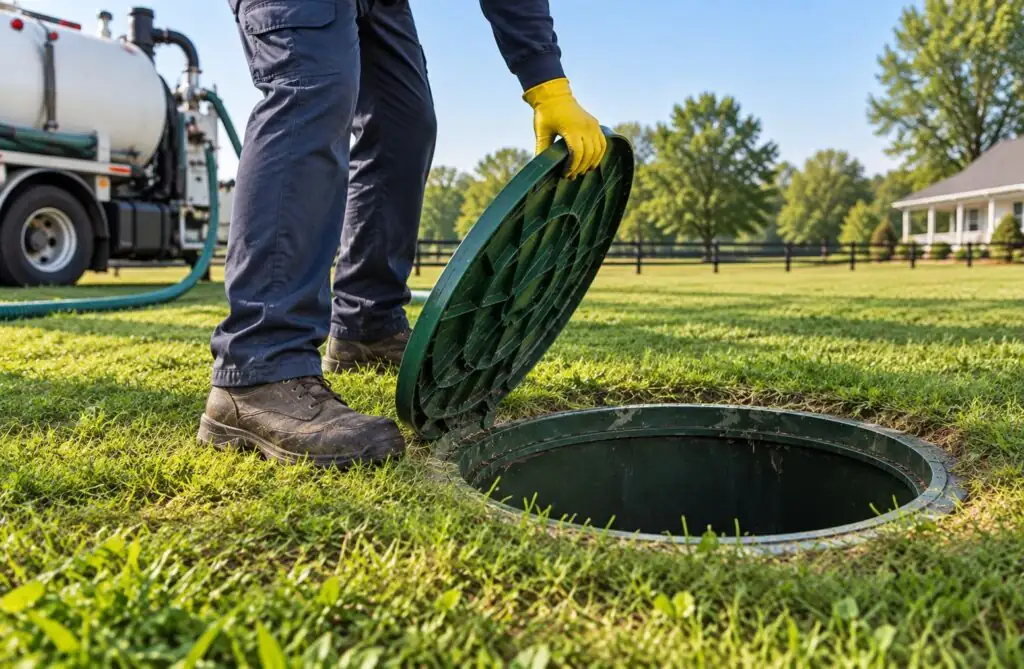
A septic system evaluation looks at condition and performance together. We open the tank at its access points, measure how far sludge has built up from the bottom and how deep the scum layer sits on top, check that the inlet and outlet baffles are still in place and doing their job, and look for cracks, corrosion or water lines that suggest the tank is no longer holding. Then we walk the drainfield for the things that only show up outside: standing water, surfacing effluent, spongy ground, root intrusion, or a stripe of grass growing faster than the rest of the lawn.
Elite Septic Service has worked on East Texas septic systems for 10 years, and the crew that repairs and replaces them is the crew that inspects them. That matters, because recognising a drainfield six months before it fails is not something you learn from a checklist.
What you get with every inspection
- A visual and measured check of the tank, lids and access risers
- Sludge and scum levels recorded, not estimated by eye
- Inlet and outlet baffles or tees checked for damage and displacement
- The drainfield walked for surfacing, saturation and root intrusion
- Photos of what we found, so you are not taking our word for it
- A written summary with plain-language recommendations and next steps
What We Inspect
What We Check During a Septic Inspection
Every inspection covers the same ground in the same order, so nothing gets skipped because the yard looked dry on the way in.
System Location & Records
We start by finding the system and reading its history: any permit or as-built records that exist, the tank and drainfield location, the system age, and whether the layout on paper matches what is actually in the ground. On older rural properties around Angelina County, that last part is not a formality.
Tank Access, Risers & Lids
Risers, lids and access ports are located and opened. Buried, cracked or sealed-over lids are a finding in their own right — a tank nobody can reach is a tank nobody can pump, and that alone shortens the life of a system.
Tank Structural Condition
Walls, baffle walls, the lid seat and the inlet and outlet penetrations are examined for cracks, corrosion, spalling concrete and displaced sections. A liquid line sitting above or below the normal operating level often says more about a tank than the concrete does.
Sludge & Scum Levels
We measure the depth of settled sludge at the bottom and the scum layer floating on top, then compare both against the tank outlet. Once either reaches the outlet, solids are leaving the tank and heading for the drainfield — which is how most fields are killed.
Inlet & Outlet Baffles or Tees
The inlet baffle slows incoming flow so solids can settle; the outlet baffle or effluent filter keeps them from escaping. Both corrode, break off or wash away, and a missing outlet baffle is one of the most common findings we write up on older systems.
Signs of Leakage or Failure
Groundwater seeping in, effluent seeping out, a liquid level sitting wrong, damp ground over the tank. We look for the evidence that a tank is no longer watertight — in both directions, because inflow is as damaging as outflow.
Drainfield Condition
The field is walked end to end for saturation, soft ground, surfacing effluent, ponding and settling. Grass that is greener, thicker and faster-growing over the trenches than anywhere else in the yard is telling you exactly where the effluent is sitting.
Effluent Lines & Root Intrusion
Where they can be reached, the building sewer line, distribution box and effluent lines are checked for fall, blockage and root intrusion. Pines and hardwoods send roots toward the wettest ground on a property, and that is precisely where the field is.
Pumps, Alarms & Aerobic Units
On aerobic and pumped systems we check the pump tank, floats, control panel and alarm, and on spray systems the heads and chlorinator. We also look for an active maintenance contract, which Texas requires on aerobic units and which buyers often do not know exists.
Overall System Performance
Finally we look at how the system behaves under normal household use: how fixtures drain, whether the tank level recovers, whether there is any backup indication at the cleanout, and whether the system is sized for the household actually living there.
Know the condition and need the work done? We also handle septic tank repair, septic tank installation and replacement, pumping and ongoing maintenance across East Texas.
Step By Step
Our Septic Inspection Process
Every inspection follows the same order, whether it is a pre-purchase evaluation on twelve acres outside Lufkin or a homeowner who wants to know why the shower has slowed to a crawl.
1. Schedule the Inspection
Tell us the address, roughly when the system went in if you know, and why you are asking — buying, selling, or something is not right. We book a time, and if the inspection is tied to a real-estate option period we work to that deadline.
2. Locate the System & Review Records
We find the tank and the field, check whatever permit or as-built records exist for the property, and note the system type and age. Knowing whether you are looking at a 1980s gravity field or a ten-year-old aerobic unit changes everything that comes next.
3. Open and Inspect the Tank
Lids and risers come off. We measure sludge and scum depths, check the inlet and outlet baffles or tees, inspect the walls and lid seat for cracks and corrosion, and note where the operating liquid level sits against the outlet.
4. Assess the Drainfield
The field is walked for surfacing effluent, saturation, ponding, settling and root intrusion, along with the ground around it and downhill of it. Most of the expensive news on a septic system is found out here, not at the tank.
5. Check Components & Performance
Pumps, floats, alarms, control panels, filters, spray heads and cleanouts are checked wherever the system has them, and we watch how it handles normal flow rather than assuming that it does.
6. Document Findings & Explain Them
You get the findings in writing with photographs, a plain description of the condition of the system, and clear recommendations — what needs attention now, what to watch, and what is simply the age of the system. Then we walk you through it.
How long does a septic inspection take?
Most residential inspections take one to three hours on site, depending on how easily the tank can be reached, the size of the drainfield, and whether the system has pumps and alarms to test. Systems with buried or sealed-over lids take longer, because the lid has to be uncovered before anything can be inspected at all. If the inspection is part of an option period, tell us the deadline when you book and we will schedule around it.
When Should You Get a Septic Inspection?
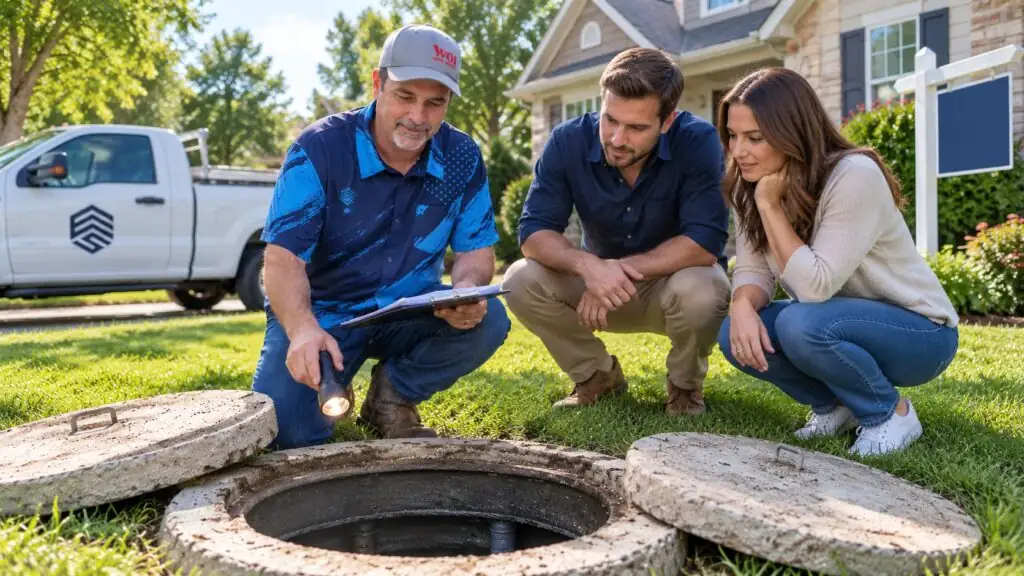
There is no single schedule that fits every property, but these are the moments when an inspection earns its cost:
- Before you buy a home or acreage with an existing system
- Before you list a property for sale
- When slow drains, odors or wet ground suggest a problem
- After heavy rain or flooding has saturated the drainfield
- Every few years as a routine check on system condition
- Before adding bedrooms, a shop bathroom or an RV hookup
- When you inherit a property and have no records for the system
If you are somewhere between two of those — not selling yet, but you would rather know — that is still a good reason to book. Finding a tired drainfield in March is a very different conversation from finding it during an option period in July.
Buyers & Sellers
Septic Inspection for Home Buyers and Sellers
A septic system is one of the few parts of a property that can quietly carry a five-figure problem and show almost nothing on a general home inspection. Here is how an inspection fits into a real-estate transaction in this part of Texas.
Buying a home in Lufkin
A general home inspection does not open the septic tank. If the property runs on a septic system, a separate inspection is what tells you whether you are buying a system with years left in it or one that will need a new drainfield before the second winter. Ask for it during the option period, while you still have room to negotiate.
Buying rural land and acreage
Older systems on rural tracts around Angelina and the neighbouring counties are often undocumented, undersized for a modern household, or installed before permitting caught up with them. An inspection tells you what is genuinely in the ground and whether the property will support what you are planning to build on it.
Selling a property
A pre-sale inspection puts you in front of the problem instead of behind it. If something needs work, you get to price it, fix it or disclose it on your own timeline — rather than renegotiating against a buyer’s inspection report three days before closing.
Lender and loan requirements
Texas has no statewide law requiring a septic inspection before a home changes hands. Federally backed loans are a different matter: FHA, VA and USDA appraisals look for evidence of a functioning on-site sewage facility, and lenders frequently ask for an inspection before they will close. Ask your lender what they need early, not the week of closing.
Aerobic systems and service contracts
Aerobic treatment units are common across East Texas because of the clay, and Texas requires them to be kept under an ongoing maintenance contract with regular testing. Buyers regularly find out at closing that the contract lapsed years ago. It is worth knowing before the keys change hands, not after.
Permits, records and ownership transfer
In Angelina County, on-site sewage facilities are permitted through the Angelina & Neches River Authority in Lufkin, and a change of ownership generally means a transfer permit. Part of an inspection is establishing what records exist for the system, because a missing permit file has held up more than one closing.
What It Turns Up
What a Septic Inspection Report Actually Tells You
An inspection is only worth having if you can act on it. Ours is written to be read by a homeowner, a buyer or an agent — not only by another septic contractor.
Problems an inspection commonly finds
- Sludge or scum built up to the level of the tank outlet
- A missing, broken or corroded outlet baffle letting solids into the field
- Cracks, spalling or corrosion in the tank walls, lid seat or penetrations
- A tank taking on groundwater, or losing effluent through a failed seal
- A drainfield that is saturated, ponding or surfacing wastewater
- Tree and shrub roots grown into the trenches, the lines or the tank itself
- Pumps, floats or alarms that have quietly stopped working
What you get in your inspection report
- A description of the system type, layout and approximate age
- Measured sludge and scum depths rather than a general impression
- The condition of the tank, baffles, lids and accessible components
- Drainfield observations, including any surfacing or saturation
- Photographs of the findings that matter
- Recommendations separated into what to fix now, soon, and simply watch
- A straight answer on whether repair or replacement is the honest option
Why Us
Why Choose Elite Septic Service for Your Septic Inspection
10 Years in East Texas
We have worked on septic systems in this part of Texas for 10 years — on sandy loam, on heavy clay, on slopes and on lots where nothing wanted to fit. Recognising a drainfield that is six months from failing takes that kind of time behind you.
A Thorough, Repeatable Inspection
Tank opened, sludge and scum measured, baffles checked, field walked. The same sequence every time, so nothing gets skipped because the yard happened to look dry on the day.
Findings in Writing, With Photos
You get documentation you can hand to a buyer, a seller, an agent or a lender — not a verbal summary you are expected to remember three weeks later.
Plain Language, Not Jargon
We explain what we found, why it matters and what it would take to put right, in terms that make sense to somebody who has never opened a septic tank.
Local Knowledge That Changes the Answer
We know the soils around Lufkin and Jasper, how the counties here handle on-site sewage permitting, and which properties tend to be running aerobic systems before we have walked the lot.
Honest Recommendations
If the system is fine, we say so. We would far rather tell you a tank has years left in it than sell you work you do not need — most of our jobs come from people who were told the truth the first time.
Licensed, Insured and Locally Based
Elite Septic Service is a locally owned, licensed and insured septic contractor with one local crew, free estimates and flat-rate pricing agreed before any work starts.

Questions worth asking any septic inspector
- Will you open the tank, or is this a visual inspection only?
- Do you measure sludge and scum levels, or estimate them by eye?
- Are the baffles or tees checked at both the inlet and the outlet?
- Does the inspection include walking the drainfield?
- Will I receive written findings and photographs?
- If the system needs work, will you explain the options?
- Are you licensed and insured for septic work in Texas?
We answer all seven before we book anything — and you should expect the same from anyone else you call.
Warning Signs
Signs Your Septic System May Need an Inspection
Any one of these on its own is not proof of a failing system. Two or three together usually means something has already changed underground, and the sooner it is looked at the more options you still have.
Drains that have slowed across the house
Sinks, tubs and toilets all draining slower than they used to — not one fixture, but several — usually points at the system rather than the plumbing. A single slow drain is a clog; the whole house slowing down is a message.
Gurgling toilets and plumbing
Air being pushed back through the traps means the line or the tank is not clearing the way it should. It is one of the earliest warning signs, and one of the easiest to ignore for another year.
Sewage odor indoors or outdoors
A working system is not something you smell. Persistent odor near the tank lids, over the drainfield or around the house points to a lost seal, a broken component or effluent reaching the surface.
Wet or spongy ground over the drainfield
Ground that stays soft when the rest of the yard has dried out means the soil is no longer absorbing what the system is sending it. That is worth measuring before it becomes surfacing wastewater.
Bright green, fast-growing grass over the field
A stripe of grass greener and thicker than the rest of the lawn is being fertilised by effluent sitting too close to the surface. It is the clearest sign visible from the yard, and the most commonly missed.
Sewage surfacing in the yard
Standing water or visible effluent above the tank or the field is a health issue as well as a system failure. Keep people and animals off it and have it looked at straight away.
Backups that return after every pump-out
If the house drains fine for a fortnight after a pump and then backs up again, the problem sits downstream of the tank. That pattern usually points at the drainfield rather than a blockage.
Heavy rain making everything worse
East Texas gets long wet spells, and a marginal drainfield shows it first. A system that only backs up after several days of rain is telling you the field has very little capacity left in reserve.
No records, and no idea how old it is
If you cannot say when the tank was last pumped, where the lids are, or whether the system was ever permitted, an inspection is the cheapest way to find out what you actually own.
Not sure whether you are looking at a pump-out, a repair or the end of a drainfield? Book an inspection and we will tell you which one it is before you spend anything on the wrong fix.
Where We Work
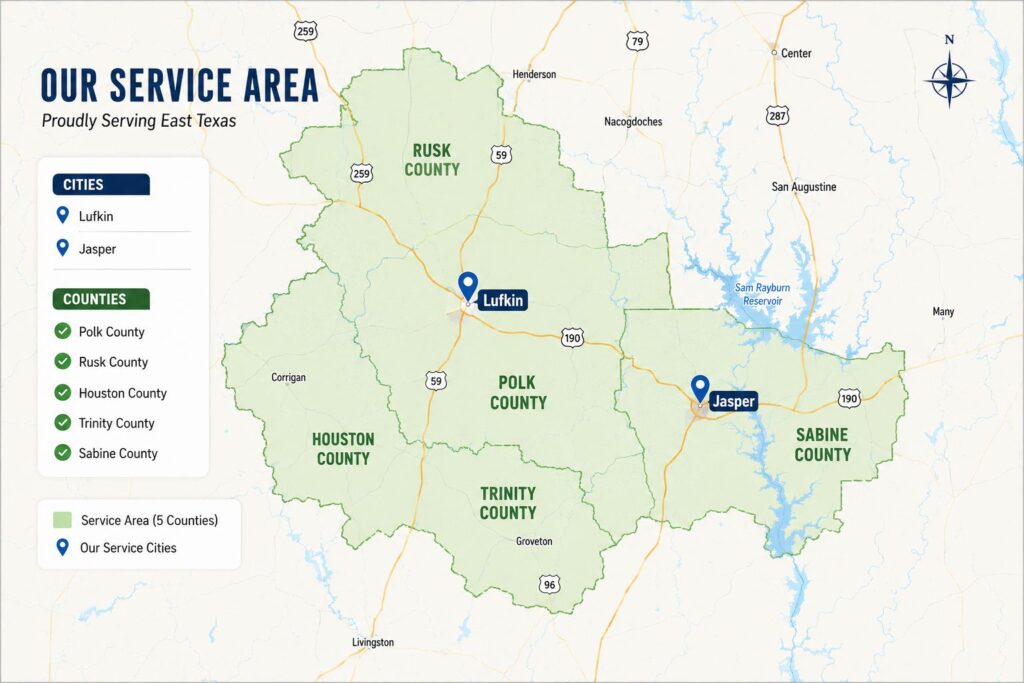
Septic Inspection Services Across Lufkin and East Texas
Local ground changes what an inspection is looking for. Much of Angelina County and the counties around it sits on heavy clay that drains slowly, which is why so many properties here run aerobic treatment units rather than conventional gravity fields — and aerobic systems bring pumps, floats, alarms, spray heads and service contracts that a tank-only inspection would never touch. Add pine and hardwood roots that head straight for the wettest ground on a lot, and the long wet spells that keep a marginal drainfield saturated for days, and you get failure patterns specific to East Texas.
Permitting is local too. On-site sewage facilities in Angelina County are permitted through the Angelina & Neches River Authority in Lufkin, and the neighbouring counties each work through their own authorized agent. Knowing where the records live is part of knowing what you are inspecting. We inspect septic systems throughout:
Once you know the condition of the system, we can handle whatever comes next: septic tank repair, septic tank installation and replacement in Lufkin, pumping and ongoing maintenance. See every one of our septic services, or check the full East Texas service area if your property is not on the list above.
More septic services in Lufkin, TX: septic tank installation, septic tank repair, septic system replacement, emergency septic service, septic system maintenance, drain cleaning, sewer line repair and sewer camera inspection. See everything we offer locally on our septic service in Lufkin, TX page.
Septic Inspection FAQs
Common questions about septic inspections for homeowners, buyers and sellers across Lufkin and East Texas. If yours is not here, call and ask.
What does a septic inspection include?
A septic inspection covers the tank and the drainfield together. We locate the system and check what permit or as-built records exist for it, open the lids and risers, measure sludge and scum depths against the tank outlet, inspect the walls, lid seat and penetrations for cracks and corrosion, and check the inlet and outlet baffles or tees. Then we walk the drainfield for saturation, ponding, surfacing effluent, settling and root intrusion. On aerobic and pumped systems we also check pumps, floats, alarms, filters and spray components. You receive the findings in writing with photographs.
When should I get a septic inspection?
The usual triggers are buying a property with an existing system, listing a property for sale, or noticing something that has changed — slow drains across the house, odor outdoors, soft or unusually green ground over the drainfield, or backups that return after every pump-out. It is also worth booking one after flooding or a long wet spell, before adding bedrooms or a shop bathroom that will raise daily flow, and when you inherit a property with no records for the system. Outside of those, a routine evaluation every few years keeps small problems from becoming drainfield replacements.
Do I need a septic inspection when buying a home in Lufkin?
Texas has no statewide law requiring one, and a standard home inspection will not open the septic tank — so the decision usually sits with you and your lender. If the loan is FHA, VA or USDA, the appraisal looks for evidence of a functioning on-site sewage facility and the lender may ask for an inspection before closing. Even on a cash purchase it is worth doing: a drainfield replacement is one of the larger bills a rural property can hand a new owner, and the option period is the only point at which you have any leverage over it.
How long does a septic inspection take?
Most residential inspections run one to three hours on site. The variables are how easily the tank can be reached, the size and layout of the drainfield, and whether the system has pumps, alarms and spray components that need testing. A tank with buried or sealed-over lids takes longer, because the access has to be uncovered before anything can be inspected. Written findings follow shortly after the visit.
What does a septic inspector look for?
Condition and performance, together. On the tank: structural cracks, corrosion, a displaced or missing baffle, sludge and scum depths relative to the outlet, and whether the liquid level suggests the tank is leaking out or taking groundwater in. On the field: saturation, ponding, surfacing effluent, settling and root intrusion. Around the property: backup indications at the cleanout, odor, and whether the system is sized for the household actually living there. On aerobic systems: the pump, floats, alarm, control panel and whether the required maintenance contract is still active.
What happens if a septic inspection finds a problem?
We tell you what it is, how serious it is, and what the realistic options are — in writing. Some findings are small and immediate: a missing outlet baffle, a cracked lid, a tank overdue for pumping. Others, such as a saturated drainfield, are the start of a replacement conversation. In a property sale, a written report with photographs is what lets buyers and sellers negotiate on facts rather than guesses. If you want the work done we can quote it at a flat rate, and if you would rather take the report elsewhere that is entirely fine.
Does a septic inspection include the drain field?
Yes, and it is not the part to skip. The tank is where problems are easiest to see, but the drainfield is where the expensive ones live. We walk the field and the ground around and downhill of it, looking for standing water, soft or spongy ground, surfacing effluent, settling over the trenches, and the stripe of faster, greener grass that shows effluent sitting too close to the surface. A tank in good order sitting in front of a failing field is a very common finding.
Do septic inspections include a written report?
Yes. Every inspection is documented: the system type, layout and approximate age; measured sludge and scum depths rather than an impression; the condition of the tank, baffles, lids and accessible components; drainfield observations; photographs of what we found; and recommendations separated into what needs attention now, what to watch, and what is simply the age of the system. It is written to be read by a homeowner, a buyer or an agent, not only by another contractor.
How often should a septic system be inspected?
For a conventional tank-and-drainfield system, an inspection every three to five years alongside pumping is a sensible rhythm — TCEQ guidance puts pumping in roughly that range, with the exact interval set by household size and tank capacity. Systems using secondary treatment or drip irrigation are on a much tighter schedule: Texas requires those to be inspected by a licensed maintenance provider every four months, under an active maintenance contract. Beyond any schedule, a change in how the system behaves is always a reason to inspect sooner.
How do I book a septic inspection in Lufkin?
Call Elite Septic Service at +1 936-208-3153 or send a request through our contact page. Tell us the address, anything you know about the system, and whether this relates to a purchase, a sale or a problem you have noticed. We will book the visit, inspect the tank and the drainfield, and give you the findings in writing with photographs. If the inspection is tied to an option period, tell us the deadline and we will work to it.
Need a Septic Inspection in Lufkin, TX?
Tell us the address, roughly what you know about the system, and whether this is a purchase, a sale or a problem you have noticed. We will book the inspection, open the tank, walk the field, and give you the findings in writing with photographs — no obligation, and no pressure to have the work done by us.
- Free estimates and flat-rate pricing agreed up front
- Licensed, insured and locally based in East Texas
- Same-week appointments, and option-period deadlines respected

Reviewed for accuracy by
Owner & Founder, Elite Septic Service. TCEQ licensed Installer II, Site Evaluator, and Maintenance Provider with 10 years in East Texas.
Last reviewed September 23, 2026