
Licensed & Insured Septic Repair
Septic Tank Repair in Lufkin, TX
Professional septic tank repair for leaks, backups, damaged components, drainfield problems and other septic system issues across Lufkin, Jasper and the surrounding East Texas communities. We diagnose the problem first, tell you what is actually wrong, and repair what can be repaired.
- 10 years of East Texas septic experience
- Licensed & insured service
- Honest repair assessment

Septic Repair Overview
What Septic Tank Repair Involves
A septic system has a lot of separate parts, and a symptom in the house rarely tells you which one has failed. Septic tank repair covers everything from resealing a leaking tank and replacing a collapsed lid to rebuilding inlet and outlet baffles, clearing or relaying a crushed line, resetting a distribution box, and replacing an effluent pump, float or alarm that has stopped doing its job.
Some of that is a same-visit fix. Some of it needs excavation. And some problems that look like a tank fault are actually a drainfield that has stopped accepting water — which no amount of work on the tank will solve. Sorting out which of those you have is the whole job.
Why diagnosis has to come first
Backups, slow drains and odors are symptoms, not diagnoses. The same backup can come from a blocked line, a failed baffle, a full tank, a stuck pump or a saturated drainfield — and the repair for each one is completely different. Guessing usually means paying twice: once for the wrong fix, and again when the problem returns a few weeks later.
Pumping is a good example. It empties the tank and the house drains again for a while, so it feels like a repair. If the drainfield is the real problem, though, pumping has bought you weeks, not a solution. A septic system inspection is what tells you which one you are dealing with before you spend anything on parts.
Repairable problem, or a system that needs replacing?
Broadly, damage to a component is repairable and loss of the system’s ability to treat and disperse wastewater usually is not. A cracked lid, a broken tee, a failed pump, a crushed section of line, a leaking joint — all of those are repairs. A tank that has structurally failed, or a drainfield that is saturated and surfacing sewage, is a different conversation, and honest advice at that point is worth more than another patch.
We will tell you which side of that line your system sits on, and if a repair only buys you a season we will say so rather than sell it to you. When replacement really is the answer, our septic tank installation service handles the design, permitting and install.
What a repair visit includes
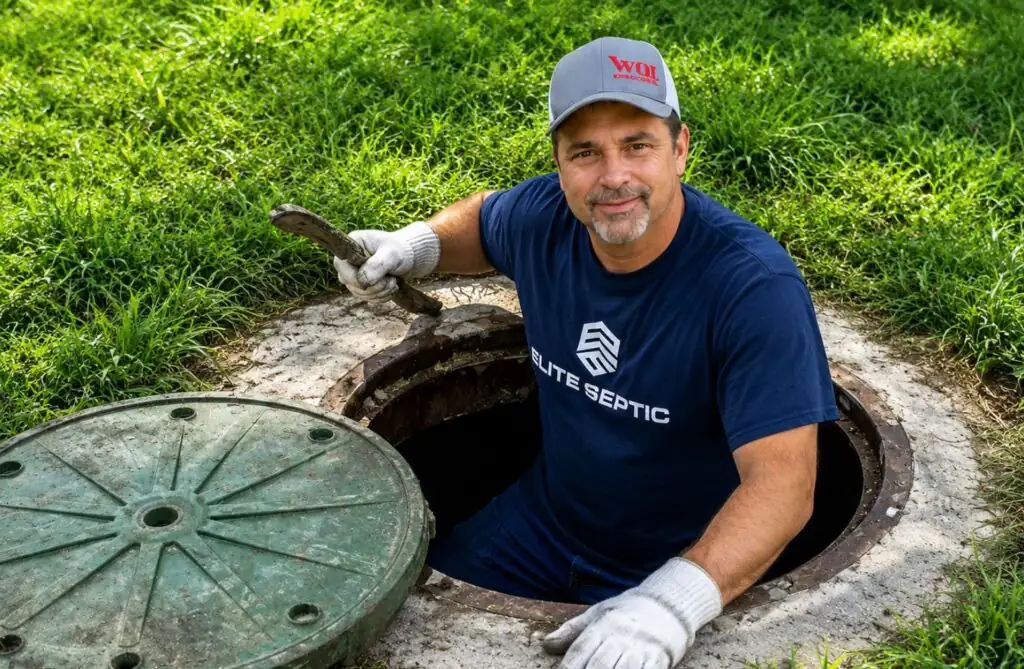
- A look at the whole system, not just the symptom you called about
- Tank, lids, baffles, lines, D-box and pump checked in order
- A plain explanation of what failed and why it failed
- A repair price agreed before any work starts
- Testing after the repair, not just refilling the hole
- Straight advice if the honest answer is replacement
Do Not Wait It Out
Why Professional Septic Repair Matters
Septic problems do not settle down on their own. They move in one direction — from a component fault you can fix, toward a system failure you have to replace. Here is what the waiting actually costs.
Backups that keep coming back
A blockage cleared without finding its cause returns, usually within weeks. Every repeat means more sewage inside the house, more disruption, and more money spent on a problem nobody has actually diagnosed yet.
Sewage odors around the property
A sealed, working system is not something you smell. Ongoing odor means gas is escaping through a failed seal, a cracked lid, a dry trap or effluent reaching the surface — and those gases are a health hazard, not just a nuisance.
A tank that is leaking both ways
A tank that has lost its watertight seal leaks untreated effluent out into the soil and lets groundwater in. The inflow overloads the drainfield with clean water it was never sized to handle, so a small leak quietly shortens the life of the whole system.
Damage to the drainfield
Solids carried past a failed baffle, or effluent forced through a broken distribution box, clog the soil in the field. That damage is cumulative and largely irreversible — and the drainfield is the most expensive part of the system to rebuild.
Contaminated groundwater and wells
Untreated wastewater escaping a failed system can reach a private well, a pond or a creek. Once bacteria show up in a well test you are dealing with a water supply problem on top of a septic one.
Damage to the property itself
Saturated ground, sinkholes over a collapsing tank, ruined landscaping and sewage inside the house are all avoidable outcomes of a problem that was left running too long.
A bigger bill than you started with
Almost every expensive septic job we are called to started as a small one. A baffle, a lid or a length of line is a modest repair; the drainfield failure that follows from ignoring it is not.
If you are seeing any of this now, the useful next step is a diagnosis rather than another pump-out. Get the system assessed and we will tell you what is actually failing.
What We Repair
Septic Tank Repair Services
Most septic faults come down to one of a dozen components. These are the repairs we are called out for most often across Lufkin, Jasper and the surrounding counties — and what each one usually means for your system.
Septic Tank Leak Repair
Leaks show up as wet ground over the tank, a tank that never seems to hold level, or clean groundwater flooding in and overloading the field. We locate the breach, and where the tank structure is still sound we reseal joints, seams and penetrations properly.
Cracked Tank Repair
Hairline cracks and localised damage in a structurally sound concrete tank can often be repaired. Widespread cracking, spalling or a wall that has started to move is a different situation, and we will tell you plainly when a tank is past repairing.
Lid Repair & Replacement
Cracked, sunken or missing lids are the most urgent safety issue on any septic system and one of the cheapest things to put right. We replace damaged lids and can fit secure risers so the tank is easy to open for future service.
Inlet & Outlet Pipe Repair
The connections into and out of the tank take the most abuse. Broken, displaced or corroded inlet and outlet pipes let solids move where they should not and are a common cause of repeat backups.
Septic Line Repair
The building sewer line and effluent lines crack, sag, separate at joints and get crushed by vehicle traffic or root intrusion. We locate the fault, expose only what we need to, and relay the affected run to correct fall.
Distribution Box Repair
The D-box splits flow evenly between drainfield lines. When it settles, cracks or its outlets clog, one line takes most of the load and fails early. Resetting or replacing the box is often what saves the rest of the field.
Effluent Pump Repair
Pumps in low-pressure, drip and aerobic systems wear out, seize, lose their seal or fail electrically. We test the pump, the controls and the circuit, then repair or replace what has actually failed rather than swapping the whole assembly by default.
Alarm & Float Repair
A septic alarm is a warning, not a fault in itself. Stuck floats, corroded connections, failed switches and dead control boards all trigger alarms — and so does a genuine high-water condition, which is why the alarm should never simply be silenced.
Baffle & Tee Repair
Inlet and outlet baffles keep solids and scum in the tank and out of the drainfield. They corrode and break, often silently. Replacing a failed baffle is a modest repair that prevents a very expensive one.
Drainfield Line Issues
Individual laterals block, crush or settle out of grade while the rest of the field is still healthy. Where the soil has not been ruined, clearing or relaying the affected lines can bring the field back into balance.
Drainfield Problems
Standing water, surfacing effluent and backups after every pump-out point at the field itself. Some causes — hydraulic overload, a broken D-box, a leaking tank — are fixable. A field that has genuinely failed needs replacing, and we will say so.
Emergency Septic Repairs
Sewage backing up into the house, effluent surfacing in the yard or an alarm sounding are not things to leave until next week. Call and we will get to you, stabilise the situation, and work out the permanent fix from there.
Not every component can be repaired, and we will not pretend otherwise. Where a part is past saving we replace it; where the system as a whole is past saving we talk to you about a new septic system instead.
Step By Step
Our Septic Tank Repair Process
Every repair follows the same order, because the order is what stops us guessing. Inspection first, diagnosis second, and no work agreed until you know what is wrong and what it costs.
1. Initial Consultation
Tell us what the system is doing — when it started, whether it follows heavy use or rain, how long since the last pump-out, and whether an alarm has sounded. That history narrows the likely causes before anyone arrives, and it tells us whether you need an emergency visit or a scheduled one.
2. Septic System Inspection
We open the tank and work through the system in order: liquid level, scum and sludge depth, inlet and outlet baffles, lids and risers, the building sewer line, the distribution box, the pump and controls where fitted, and the condition of the ground over the drainfield.
3. Problem Diagnosis
The inspection findings are what identify the fault — not the symptom. A high liquid level, a missing outlet tee, a collapsed line and a saturated field all produce a backup, and each one is a different repair. We confirm the cause before recommending anything.
4. Repair Recommendation
You get a plain explanation of what has failed, what it will take to put right, and a firm price before we start. If there is more than one sensible option, or if a repair only buys you a season, we lay that out too so you can decide with the full picture.
5. Repair Work
We carry out the agreed repair — resealing, replacing components, relaying line, resetting the distribution box, or servicing pumps and controls. Excavation is kept to what the job needs, and the ground is restored when we are finished.
6. Testing & Final Check
Before we leave, the system is run and checked: flow through the repaired section, liquid levels settling where they should, pumps cycling, floats and alarms responding. We then walk you through what was done and what to watch for.
How quickly can you get out?
Emergencies — sewage inside the house, effluent surfacing in the yard, an alarm sounding — get priority and we will work to reach you the same day where we can. Non-urgent repairs are usually scheduled within the week. Most straightforward repairs are completed in a single visit; anything that needs excavation, a fabricated part or a permit for major work will take longer, and we will tell you that up front rather than after we have started.
Know What You Are Seeing
Common Septic Tank Problems
The same handful of faults account for most of the septic problems we see in East Texas. Knowing what each symptom usually points to will not fix your system, but it will help you describe it accurately and avoid paying for the wrong repair.
Sewage backing up into the home
The most alarming symptom and the least specific one. It can mean a blocked building sewer line, a failed outlet baffle, a tank that is full because the drainfield has stopped accepting water, or a pump that is no longer running. Stop using water in the house and get it looked at before it is cleared blind.
Slow drains throughout the house
One slow fixture is usually a household plumbing problem. Every fixture draining slowly at the same time points at the system rather than the plumbing — commonly a partially blocked line, a high liquid level in the tank, or a drainfield that has begun to fail.
Foul septic odors
A properly sealed system is not something you smell. Odor outdoors suggests a cracked or unsealed lid, a broken vent, a failed seal at a pipe penetration, or effluent reaching the surface. Odor indoors is more often a dry trap or a plumbing vent issue, and both are worth ruling out.
Standing water near the septic system
Wet ground over the tank or the field when it has not rained means water is escaping where it should be contained, or the field can no longer absorb what it is being given. Keep people and pets off the area until it has been assessed.
Unusually green, spongy grass over the drainfield
Grass that is greener and grows faster over the field than anywhere else in the yard is being fertilised by effluent sitting too close to the surface. It is an early warning, and it is far cheaper to act on at this stage than after water starts standing.
A cracked or damaged tank
Concrete cracks and spalls; older steel tanks corrode from the inside out. Localised damage in an otherwise sound tank can often be repaired, but a tank that has lost structural integrity is a collapse risk and needs replacing, not patching.
Broken, sunken or missing lids
The most urgent safety problem a septic system can have, and one of the cheapest to fix. A damaged lid is a fall hazard and it lets surface water into the tank. If a lid is missing or cracked, cover the opening safely and call the same day.
A failed effluent pump
Systems that pump effluent depend on that pump entirely. Pumps seize, lose their seal, burn out or fail electrically, and the first sign is usually the high-water alarm. Sometimes the pump is fine and the float, breaker or control board is the actual fault.
The septic alarm going off
The alarm means the liquid level has risen past where it should be. That may be a failed pump, a stuck float, a wiring fault, or genuine hydraulic overload. Silence the audible alarm if you need to, reduce water use, and get it diagnosed — do not simply switch it off and carry on.
Damaged or blocked pipes
Lines crack, sag, separate at joints, get crushed by vehicle traffic and get invaded by roots. The result is either a blockage or effluent escaping into the ground alongside the pipe. Locating the exact fault first is what keeps the excavation small.
Drainfield failure
When the soil in the field can no longer absorb effluent, everything upstream backs up. Overloading, solids carried past a failed baffle, compaction from vehicles and long-term neglect are the usual causes. Some contributing faults are repairable; a field that has genuinely failed has to be replaced.
Why repeated pumping is not a repair
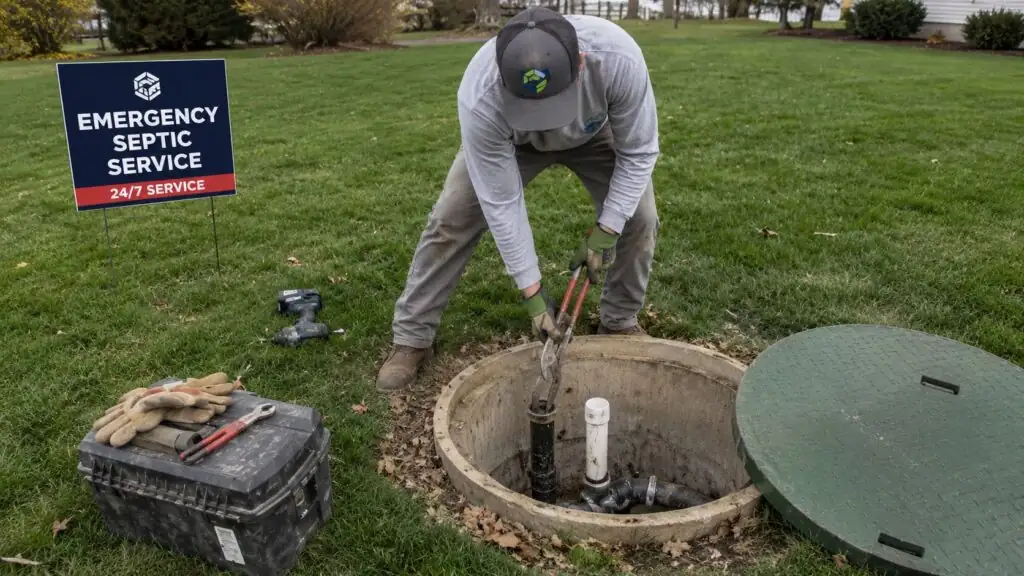
Pumping empties the tank, and an empty tank buys the house a few weeks of normal drainage. That is genuinely useful as routine maintenance, and it is the right first move in an emergency — but it does not repair a broken baffle, a crushed line or a drainfield that has stopped absorbing.
If you are pumping more often than every few years to keep things working, the pump-out is treating a symptom. The question worth answering is why the tank is filling that fast.
Warning Signs
Signs You Need Septic Tank Repair
Septic systems give plenty of warning before they fail outright. Here is what each of the common signs usually indicates — and why an assessment beats another pump-out or another few months of hoping.
Backups that return after every pump-out
If the house drains fine for a couple of weeks after a pump and then backs up again, the tank was never the problem. That pattern usually points to a failed outlet baffle or a drainfield that has stopped absorbing — and pumping it again only resets the clock.
Every drain in the house running slow
One slow fixture is plumbing. Every sink, tub and toilet slowing at once is the system telling you flow is restricted somewhere past the house — a blocked line, a high liquid level, or a field at capacity.
Sewage odor outside the house
A sealed system does not smell. Persistent odor around the tank, the lids or the field means gas is escaping through a failed seal or effluent is reaching the surface. Both are worth an inspection rather than an air freshener.
Wet ground or standing water over the system
Soggy ground over the tank or drainfield in dry weather means water is going where it should not. Keep people and pets off it, and get it assessed before the saturated soil damages the field permanently.
A strip of grass that is greener than the rest
Grass growing faster and greener over the drainfield is being fed by effluent sitting near the surface. It is the earliest visible warning you get, and the cheapest point at which to act.
An alarm sounding, or a pump that will not run
On a pumped or aerobic system the alarm is the first thing you will notice. It may be the pump, a stuck float, the breaker or the control board — but it always means the level has risen past normal, and it should be diagnosed rather than muted.
Gurgling fixtures and water rising at the lowest drain
Air being pushed back through the traps, and the shower or floor drain filling first, are early signs of a restriction building. Acting here often turns a backup into a straightforward line repair.
Which One Do You Need
Septic Repair vs. Septic System Replacement
The honest answer is that nobody can tell you which one you need from the symptoms alone. What follows is the general rule — but the decision belongs to an inspection, not to a phone call or a guess.
When septic repair makes sense
- Minor pipe and line damage — a cracked or separated section that can be exposed and relaid
- Broken, cracked or sunken lids, and risers that no longer seal
- Pump faults, stuck floats, failed switches and control-panel problems
- Damaged fittings, inlet and outlet tees, and corroded baffles
- A distribution box that has settled, cracked or partially blocked
- Localised cracking or a leaking joint in a tank that is still structurally sound
- Isolated component failures on a system that is otherwise performing normally
What these have in common is that the system itself still works — one part of it has failed, and replacing that part restores it.
When replacement may be necessary
- A tank that has structurally failed — collapsed, badly corroded or cracked through
- A drainfield that is saturated, surfacing effluent and no longer absorbing
- Several components failing at once across an aging system
- Major repairs that keep recurring year after year on the same system
- A system too small for the household after an addition, remodel or extra bathroom
- A system that was never permitted and cannot be brought into compliance as it stands
Here the system has lost its ability to treat and disperse wastewater. Further repairs buy time rather than fix the cause, and the money is usually better spent on a properly designed new system.
An inspection is what settles it
Two properties with identical symptoms can need completely different work. The only reliable way to know whether you are looking at a repair or a replacement is to open the tank, check each component in turn, and look at how the drainfield is behaving. We will give you that answer straight — including when the answer is that a repair is not worth your money.
Why Us
Why Choose Elite Septic Service for Septic Repair
10 Years of East Texas Experience
A decade of opening tanks around Lufkin, Jasper and the surrounding counties. Most faults we see, we have seen before — which is what makes the diagnosis quick and the repair right the first time.
Licensed & Insured
A licensed, insured septic contractor doing the work, with the paperwork in order. That matters on any job that touches a permitted on-site sewage facility, and it matters if anything ever needs to be shown to a buyer or an authorized agent.
Experienced Technicians
The crew that inspects your system is the crew that repairs it. Nothing gets handed off to someone who was not there when the tank was open and did not see what we saw.
Accurate Diagnosis
We work through the system in order rather than jumping to the most likely answer. That takes a little longer on site and saves a great deal of money afterwards, because you only pay for the repair you actually need.
Quality Workmanship
Correct fall on relaid line, proper seals at every penetration, components installed to spec and the ground restored properly. The parts nobody sees are the parts that decide whether the repair holds.
Transparent Communication
A firm price agreed before work begins, a clear explanation of what failed, and a call before anything changes. No surprise line items appearing at the end of the job.
Honest Repair Recommendations
If a repair will only buy you a season, we say so. If pumping is all you need today, we say that too. We would rather lose a job than sell you work that does not solve your problem.
Local East Texas Knowledge
We know how the soils around Lufkin and Jasper behave after heavy rain, how the counties here handle permitting, and which systems in this area tend to fail in which way. Local context shortens the diagnosis.
Reliable Service
We show up when we said we would, we prioritise genuine emergencies, and we tell you promptly if anything changes. When there is sewage in the house, being reachable matters as much as being skilled.

What you will hear from us
- What has failed, and what caused it to fail
- Whether it is a repair or the start of a bigger problem
- What the repair costs, before we begin
- How long the repair should reasonably last
- When a repair is not worth your money
- What to do differently so it does not happen again
The Payoff
What a Professional Septic Repair Gives You
A septic repair done properly is not just a working toilet again. It is a system you can stop thinking about, and a drainfield you have not quietly shortened the life of.
A proper diagnosis
You find out what has actually failed, not just what the symptom looked like. That is the difference between fixing your septic problem and paying to fix something that was never broken.
The correct repair, done once
The right part, the right method, the right materials, and a repair sized to the fault. Components installed to spec and lines relaid to correct fall do not need doing again next season.
Far fewer repeat problems
When the underlying cause is addressed rather than the symptom, the backups and the alarms stop coming back. Most of the recurring problems we are called to were never diagnosed in the first place.
Safer septic operation
Secure lids, sealed tanks and contained effluent mean no fall hazard in the yard, no sewage gases escaping, and no untreated wastewater where children and pets play.
Protection for your property
A repaired system stops saturating the ground, undermining the yard and threatening a well or a pond — and it keeps the paperwork on your septic system clean for the day you sell.
Better long-term performance
Every repair that protects the drainfield extends the life of the whole system. Looking after the small failures is what keeps you from paying for the big one.

Where We Work
Septic Tank Repair Service Areas
We carry out septic tank repair across Lufkin, Jasper and the surrounding East Texas counties, for homes, rural properties, shops and rental houses alike. If you are somewhere in this stretch of East Texas and your system is misbehaving, we can get to you.
Not on the list but nearby? Call and ask — we cover a wide stretch of East Texas, and you can see the full Elite Septic Service coverage area. If the repair turns out to be a replacement, our septic tank installation service covers the same counties.
More septic services in Lufkin, TX: septic tank installation, septic tank inspection, septic system replacement, emergency septic service, septic system maintenance, drain cleaning, sewer line repair and sewer camera inspection. See everything we offer locally on our septic service in Lufkin, TX page.
Septic Tank Repair FAQs
The questions homeowners across Lufkin, Jasper and East Texas ask us most about septic repair, cost and what to do when something goes wrong. If yours is not here, call and ask.
How do I know if my septic tank needs repair?
The usual signals are backups or slow drains throughout the house, sewage odor outdoors, wet ground or standing water over the tank or drainfield, grass that is noticeably greener and spongier over the field, gurgling fixtures, or an alarm sounding on a pumped system. Any one of those is worth an inspection. Two or more at the same time usually means something has already failed rather than is about to.
How much does septic tank repair cost?
It depends entirely on which component has failed and how much digging it takes to reach it. Replacing a lid, a float or a baffle sits at the low end. Relaying a section of line, resetting a distribution box or replacing an effluent pump costs more. Work involving the drainfield is the most expensive, which is exactly why the small repairs are worth doing early. We inspect first and give you a firm price before any work starts, so you are never approving an open-ended job.
Can a cracked septic tank be repaired?
Sometimes. Hairline cracks and localised damage in a tank that is still structurally sound can be sealed and repaired. But a tank with widespread cracking, spalling concrete, a wall that has shifted, or severe corrosion on an older steel tank is not a repair candidate — it is a collapse risk and a safety issue. We will tell you which of the two you have after we have opened it and looked, not before.
Can a septic tank leak be repaired?
Often, yes. Leaks at pipe penetrations, riser joints and seams can usually be resealed where the tank body is intact. What matters is finding out where the leak is and which way it runs: effluent leaking out is an environmental and health problem, while groundwater leaking in overloads the drainfield with water it was never designed to handle. Both shorten the life of the system, and both are worth fixing promptly.
How long does septic tank repair take?
Most straightforward repairs — lids, baffles, floats, pumps, a short run of line — are completed in a single visit, often in a few hours. Repairs needing significant excavation, a part that has to be ordered, or work on the drainfield take longer and are usually scheduled over a day or two. We will tell you which category your job falls into once we have diagnosed it, rather than after we have started digging.
Can you repair septic tank pipes?
Yes. The building sewer line, the inlet and outlet connections, effluent lines and drainfield laterals can all be repaired or relaid. The important part is locating the exact fault first — a crushed section, a separated joint, root intrusion or a run that has settled out of grade — so the excavation stays small and the repair is made to the correct fall. Guessing at pipe locations is how a modest repair turns into a trenched yard.
Should I repair or replace my septic system?
As a rule, component failures are repaired and system failures are replaced. A broken lid, a failed pump, a damaged baffle or a cracked length of line are repairs. A structurally failed tank, a drainfield that has stopped absorbing, or a system that keeps needing major work is usually telling you it has reached the end. Only an inspection can settle it for your property, and we would rather give you that answer honestly than sell you a repair that buys a season.
Can septic tank problems cause sewage backups?
Yes, and it is the most common reason a septic system backs up. A blocked building sewer line, a failed outlet baffle letting solids into the field, a tank that is full because the drainfield can no longer accept water, or a pump that has stopped running will all push wastewater back toward the house. Because each of those needs a different fix, the backup itself does not tell you what is wrong — the inspection does.
What should I do if my septic alarm is going off?
The alarm means the liquid level has risen above where it should be. Cut water use in the house right away — no laundry, no dishwasher, short showers — and you can silence the audible alarm, but leave the system alone otherwise and call for service. Do not switch the alarm off and carry on: it is warning you that effluent is backing up, and the longer it runs in that state the more likely it is to reach the house or the surface.
How often should a septic system be inspected?
A conventional system is generally worth inspecting every one to three years, and it makes sense to do it at the same visit as a pump-out while the tank is open. Aerobic systems need much closer attention: in Texas, aerobic units serving single-family homes require an initial two-year service policy with regular testing and inspection, and that maintenance should continue afterwards. Inspect sooner than scheduled if anything changes in how the system behaves.
Can pumping fix a septic problem permanently?
No. Pumping removes the accumulated solids from the tank, which is essential routine maintenance and often the right first move in an emergency — but it does not repair anything. If the drainfield has failed, a baffle is broken or a line is crushed, the tank simply fills again and the same symptoms return. If you find yourself pumping far more often than every few years to keep the house draining, the pump-out is managing a symptom and the underlying fault still needs diagnosing.
Need Septic Tank Repair?
Septic problems get more expensive the longer they run. Tell us what your system is doing and we will inspect it, tell you exactly what has failed, and quote the repair before we touch anything — and if the honest answer is that a repair is not worth it, we will tell you that too.
- Free, no-obligation repair assessment
- Licensed & insured East Texas contractor
- Local crews across Lufkin, Jasper and beyond

Reviewed for accuracy by
Owner & Founder, Elite Septic Service. TCEQ licensed Installer II, Site Evaluator, and Maintenance Provider with 10 years in East Texas.
Last reviewed September 23, 2026