Septic System Costs in East Texas: What Actually Drives the Price
Typical 2026 price ranges for conventional and aerobic systems in Texas, the site factors that push cost up or down, yearly running costs and how to compare quotes fairly.
July 15, 2026 · Damon Malnar · Septic Services
In this article
A lot of homes around Lufkin, and most homes in rural Angelina County and the surrounding counties, are not on city sewer. They rely on a septic system buried somewhere in the yard. For a buyer, that system is one of the most expensive components of the property you cannot see, and one of the few that can cost well into five figures if it has failed.
Texas does not require a septic inspection when a home is sold, and a standard home inspection does not fully evaluate the system. That leaves the job to the buyer. This guide explains why a dedicated septic inspection is worth doing, what a proper one includes, the paperwork to ask the seller for, the red flags to watch for, how to handle problems during the option period, and what you need to do after closing.
There are three reasons we recommend a septic inspection on every home purchase that involves a septic system.
Texas has no statewide requirement for a septic inspection at the point of sale. What the law does require is disclosure. Residential sellers complete a Seller’s Disclosure Notice, which asks whether the property is served by an on-site sewer facility and about known defects. When a septic system exists, the Texas REALTORS “Information About On-Site Sewer Facility” form is typically completed and attached, with details such as the type of system, its age and its maintenance history.
Lenders are the other factor. FHA, VA and USDA loans often require the septic system to be evaluated or to show no signs of failure before closing, and a conventional lender may ask for an inspection if the appraiser notices problems. Even with a cash purchase, skipping the inspection is a risk you take on yourself.
A general home inspection is valuable, but when it comes to the septic system it is usually limited to what can be seen from the surface: whether drains flow, whether there are obvious odors or wet spots. The home inspector typically does not open and pump the tank, measure sludge, inspect the baffles, probe the drain field or test an aerobic unit’s components. Many home inspection reports simply recommend a separate septic evaluation, and that is the recommendation to follow.
Before anyone digs, the inspector checks the permit history. In Angelina County, septic permits and licenses are handled by the Angelina & Neches River Authority (ANRA), which keeps records for permitted systems. The file can show when the system was installed, what it was designed for (including the number of bedrooms), whether it is an aerobic system with a recorded affidavit, and whether it holds a License to Operate.
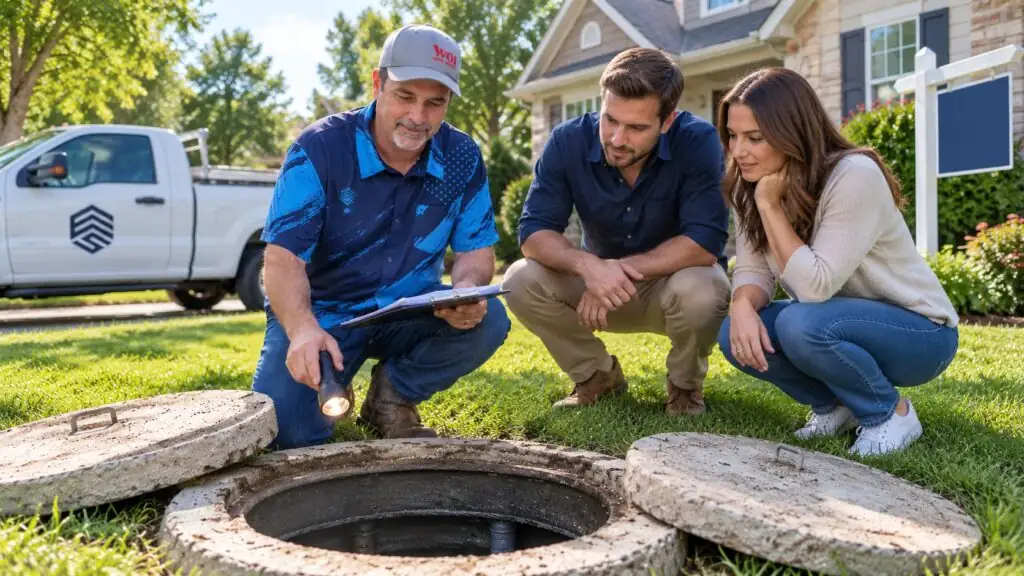
The tank is located, and every lid is uncovered. A tank with no risers and buried lids is a small red flag in itself, because it suggests it has not been serviced regularly.
The most useful inspections are done with the tank pumped, so the inspector can see the walls, the floor, the inlet and outlet baffles and the effluent filter. Before pumping, the liquid level is noted; a tank that is running above its outlet points to a problem downstream. The inspector checks for cracks, root intrusion, missing or broken baffles and signs that solids have been leaving the tank.
The drain field is probed to check for ponded effluent in the trenches, and the surface is checked for wet areas, odors and unusual grass growth. Where appropriate, lines can be inspected with a camera. On aerobic systems, the spray heads, dispersal area and setbacks are checked.
If the home has an aerobic treatment unit, the inspector tests the aerator, the effluent pump, the floats, the timer, the alarm and the chlorinator, and checks whether a maintenance contract is in place and current.
You should receive a written report with photos, describing the system, its condition, any defects found and recommended repairs. That report is what you will use to negotiate. See our septic inspection service for what our reports include.
A seller who can produce a tidy folder of records is usually selling a system that has been looked after. A seller who does not know where the tank is, or when it was last pumped, is telling you something too.
| What you find | Why it matters |
|---|---|
| No permit on file, or no License to Operate | An unlicensed system cannot be transferred to you, and bringing it into compliance can be costly. |
| Wet or spongy ground over the drain field | Classic sign of a failing or overloaded field. |
| Tank liquid level above the outlet | Effluent is not leaving; points to a field or line problem. |
| Missing or broken baffles | Solids may have been escaping into the drain field. |
| More bedrooms than the system was permitted for | The system may be undersized for the house. |
| Aerobic system with no current maintenance contract | Maintenance may have been neglected, and a contract is required. |
| Vehicles or structures over the drain field | Compaction or damage to the field is likely. |
| Tank pumped days before the inspection | Can hide a slow drain field; ask when and why. |
Most Texas residential purchases use a contract with an option period, a short window during which the buyer can terminate for any reason. Schedule the septic inspection early in that window so there is time to get repair quotes, and make sure the house has had normal water use in the days beforehand if it has been vacant. Your agent can advise on how to handle the results within the terms of your contract.
A problem is not necessarily a deal-breaker. It is information. Common outcomes include:
Get repair estimates from a licensed contractor during your option period so you are negotiating from real numbers. Our septic repair and replacement pages explain the typical fixes.
In Texas, a septic system is part of the real property, and its license follows the deed, but the transfer is not automatic. In Angelina County, ANRA requires the new owner to submit a license transfer application with a transfer fee (listed by ANRA at $35). Unlicensed systems cannot be transferred.
If the home has an aerobic system, ANRA recommends having the manufacturer or dealer inspect the components and update the service policy, and keeping the system under a maintenance contract. Set up that contract right away. The obligation to maintain an aerobic system falls on the owner from the day you take possession.
Once you own it, a few habits keep it healthy: pump the tank on a sensible schedule, keep wipes, grease and chemicals out of the drains, and keep vehicles and trees off the drain field. Our guides on how often to pump a septic tank and what not to flush are a good place to start.
Find out early which kind of system the home has, because the ownership obligations are very different. A conventional system has no required maintenance contract; you pump it every few years and keep the drain field protected. An aerobic system must be covered by a maintenance contract with inspections every four months, at least for the first two years, and it has mechanical parts (an air pump, an effluent pump, floats, a timer, an alarm and a chlorinator) that wear out and need replacing over time. It also costs more to run, with electricity and chlorine tablets on top of the contract.
None of that makes an aerobic home a bad buy. In much of East Texas, aerobic is the only system the soil allows. But you should budget for it, and ask to see the maintenance history. Our comparison of aerobic vs. conventional systems explains the running costs in detail.
Good questions, asked early, often tell you more than the paperwork:
Write the answers down and compare them with what the inspection finds.
If you are buying raw land rather than a finished home, the septic question comes even earlier. The type of system a lot can support is decided by a site evaluation of the soil, groundwater and slope. A lot that needs an aerobic system costs more to develop than one that can take a conventional drain field, and on some small or wet lots the options are limited. Where you can, get a site evaluation before you close. Our Texas sizing guide and cost guide help you budget.
Usually the buyer, as part of their due diligence, though it can be negotiated. Some sellers commission a pre-listing inspection to reassure buyers.
A typical residential inspection takes a few hours on site, longer if the tank has to be located and uncovered or if the system is aerobic.
No inspection can guarantee future performance. It tells you the system’s condition today and flags the problems most likely to cause trouble, which is what you need to make a decision.
Yes, ideally as part of the inspection itself, so the inspector sees the levels before pumping and the interior after.
A well-maintained, properly permitted system with good records is simply part of a rural home. A failing, unpermitted or undersized one can reduce value or complicate financing. That is exactly why an inspection is worth doing before you buy.
Buying a home on septic in Lufkin or anywhere in East Texas? Elite Septic Service provides real-estate septic inspections with a written report and photos, scheduled to fit inside your option period. Schedule an inspection or read more about our septic inspection service in Lufkin.

Written by
Owner & Founder, Elite Septic Service
10 years installing, repairing, and inspecting septic systems across Lufkin, Jasper, and the surrounding East Texas counties.
TCEQ licenses
Typical 2026 price ranges for conventional and aerobic systems in Texas, the site factors that push cost up or down, yearly running costs and how to compare quotes fairly.

A practical pumping schedule by tank size and household size, the measurements that tell you it is time, and the habits that stretch the interval.
Slow drains, gurgling, odors, soggy ground and backups: what each warning sign means, how urgent it is, and what to do right away.